AthenaMain

Welfare First: Retaining Nigeria’s Health Workforce in an Era of Global Competition

Executive Summary Nigeria is losing its health workforce at a pace that increasingly threatens system viability. Between 2021 and early 2024, more than 42,000 nurses emigrated, while thousands of Nigerian-trained doctors registered to practise abroad, particularly in the United Kingdom. Survey evidence suggests that outflows are likely to persist: nearly three-quarters of current medical and nursing students report an intention to work overseas, and one-third indicate no plans to return. Available evidence indicates that emigration is driven primarily by domestic welfare and governance failures rather than by professional ambition alone. Key push factors include low and irregular remuneration, unsafe and overstretched working environments, limited access to funded specialist training, and weak social protection. These conditions intersect with sustained international demand and increasingly structured recruitment practices in destination countries. In response, Nigeria adopted a National Policy on Health Workforce Migration in 2023, aimed at promoting ethical recruitment and improving retention. Early implementation reviews, however, suggest that the policy has had a limited effect on outward flows. Weak financing, uneven state-level execution, and poor translation of policy commitments into tangible welfare improvements at the facility level have constrained impact. Migration, in this context, reflects a rational response to institutional uncertainty and uneven service conditions. This policy brief argues that meaningful retention is achievable, but only if welfare reform is treated as a core economic and governance priority rather than as a subsidiary component of migration management. It proposes a Welfare-First Retention Package (WFRP) centred on guaranteed and predictable remuneration, improved workplace safety, funded career progression pathways, fair and enforceable bonding arrangements, strengthened social protection, and disciplined use of bilateral and ethical recruitment instruments. The proposed reforms are designed for implementation by the Federal and State Ministries of Health, professional regulators (including the NMCN and MDCN), teaching hospitals, and development partners such as the WHO and World Bank. The effectiveness of the reforms, however, depends on being embedded within a politically feasible, fiscally credible, and legally enforceable framework that explicitly accounts for vested interests, state-level fiscal disparities, and constitutional constraints under Nigeria’s federal system. If adequately funded and effectively governed, the package could reduce short-term attrition by approximately one-third within two years. It would also substantially improve medium-term retention over a five-year horizon, while better protecting Nigeria’s public investment in health worker training.

Strengthening Democratic Consolidation in Nigeria: Citizen Engagement, Participatory Governance, and Institutional Trust

Executive Summary

Nigeria’s democratic consolidation is constrained by weak citizen engagement and declining trust in formal channels, producing low electoral legitimacy, policy capture, and social unrest. Voter participation fell to a post-1999 low in the 2023 general elections (26.7 per cent turnout), undermining representation and the strength of the mandate. However, previous reforms – such as the Bimodal Voter Accreditation System (BVAS), expanded civic education, and donor-funded participation programmes – improved electoral administration but did not succeed in reversing distrust or increasing regular civic participation owing to uneven implementation, security challenges, and limited local-level inclusion.

This study finds that Nigerians remain willing to engage, yet channel their energy into protests or apolitical survival strategies when formal avenues feel unresponsive. Afrobarometer’s 2025 analysis shows sustained civic intent but fragile institutional confidence.

The policy recommendations include (i) institutionalising participatory budgeting and ward-level deliberative councils; (ii) strengthening INEC’s transparency and local outreach while expanding secure, accountable digital feedback platforms; (iii) empowering LGAs with ring-fenced engagement funds and civic-education mandates; and (iv) coordinating donor support towards capacity-building for civil society and local government.

The above recommendations, when implemented, will raise electoral and civic participation, rebuild trust, and improve Nigeria’s Voice and Accountability governance indicators, advancing democratic consolidation and policy responsiveness.

Judicial Independence in Nigeria: Institutional Constraints, Reform Pathways, and Democratic Consequences

Executive Summary Nigeria’s judiciary is constitutionally independent but institutionally vulnerable. The central failure is not the absence of laws or funding, but the lack of enforceable constraints on executive discretion over judicial appointments, discipline, and the release of statutory funds. If this gap persists, judicial reform will remain cosmetic. Delayed appointments, discretionary funding releases, and procedurally irregular disciplinary actions will continue to weaken court authority, prolong case backlogs, erode investor confidence, and normalise executive non-compliance with judicial decisions—undermining democratic consolidation and the rule of law. The most decisive reform lever is the institutionalisation of binding enforcement mechanisms: transparent, time-bound appointment rules; a ring-fenced Judiciary Fund with automatic releases; and codified disciplinary procedures backed by legal sanctions for non-compliance. Without enforceable limits on executive discretion, increased budgets and policy declarations will not translate into judicial independence in practice. Crucially, the brief argues that judicial reform will fail unless formal rules are matched by enforceable constraints on executive discretion. Without clear sanctions for delayed funding releases, ignored appointment timelines, or procedurally irregular disciplinary actions, reforms risk remaining declaratory rather than operative.

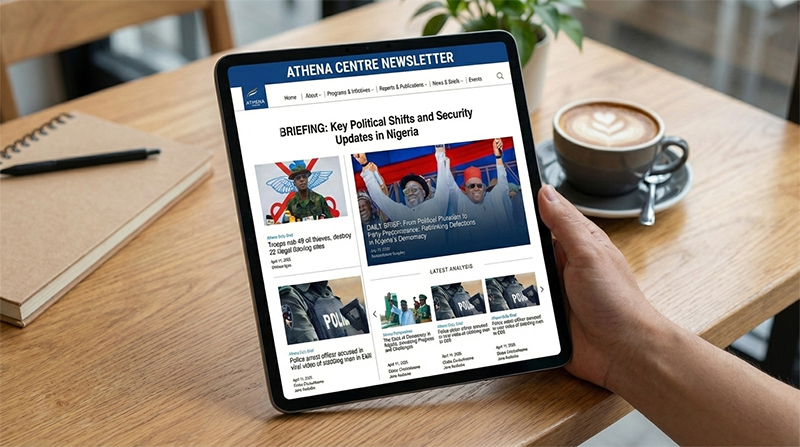
Elite Defections, Opposition Fragmentation, and the Risk of Party Predominance in Nigeria

Executive Summary Nigeria’s formal multiparty democracy is entering a period of heightened vulnerability, with structural indicators pointing toward the gradual consolidation of de facto one-party predominance. Since 2023, elite defections, strategic political alignments, and weak enforcement of party-regulation rules have produced a measurable realignment of power in favour of the ruling All Progressives Congress (APC). This trend accelerated dramatically in 2025, when three governors from historically PDP strongholds—Delta, Akwa Ibom, and Enugu—defected to the APC, joining earlier waves of political elites who crossed over after the 2023 elections. These defections were not merely symbolic; they shifted the balance of power at the subnational level and provided critical momentum to the ruling party’s expansion strategy. With these realignments, APC now controls over two-thirds of state governments, significantly weakening the institutional capacity of opposition parties and altering the calculus of legislative oversight and executive bargaining. The problem is institutional, not merely electoral. Ambiguities in anti-defection provisions, opaque party-finance practices, and limited enforcement of internal party democracy have lowered the personal and political costs of switching allegiance. Under current arrangements, defectors retain both office and access to public resources, thereby undermining representative accountability and deepening voter cynicism. Comparative experience—from India’s anti-defection amendments, Mexico’s electoral-management reforms, and South Africa’s evolution under dominant-party dynamics—demonstrates that, without deliberate institutional correction, competitive politics can erode even when elections remain regular and formally multiparty. To address these risks, this brief proposes a coordinated Electoral Integrity and Party Resilience Package (EIPRP). The package integrates enforceable anti-defection rules, transparent and conditional party financing, strengthened electoral autonomy, minimum standards for intra-party democracy, and expanded civic engagement. These reforms aim to realign elite incentives with democratic accountability by increasing the institutional cost of opportunistic switching, constraining incumbency-based advantages, and restoring the electoral returns to programmatic competition. The evidence presented in this analysis suggests that isolated reforms will not suffice. Only an integrated and enforceable package—supported by statutory clarity, institutional autonomy, and sustained civic pressure—can interrupt Nigeria’s slide toward dominant-party rule and rebuild the foundations of a competitive democratic order.

World Day of Remembrance for Road Traffic Victims: Nigeria Cannot Endure Another Decade of Road Trauma

Executive Summary Nigeria’s road-safety crisis continues to impose substantial human and economic costs. In 2024, the Federal Road Safety Corps (FRSC) recorded 5,421 deaths, even as total crashes declined by 10 per cent. This divergence underscores a critical trend: fatality severity is rising, signalling deeper systemic weaknesses rather than fluctuations in traffic volume. The burden is concentrated along a limited set of high-risk corridors and driven largely by commercial fleets, which accounted for 70.6 per cent of crashes in Q2 2025. These patterns point to the need for targeted interventions rather than broad, undifferentiated measures. Reversing this trajectory requires sustained commitment across six reform pillars: (1) dedicated and predictable financing; (2) corridor prioritisation based on risk; (3) strengthened commercial-fleet regulation; (4) reliable emergency medical response; (5) improved data systems; and (6) behaviour-change strategies supported by consistent enforcement. These measures are well-established in global practice; what has been lacking is implementation at scale. Nigeria now has an opportunity to adopt a more coherent, data-driven approach to road safety—one capable of reducing fatalities and improving transport resilience in the long term.

Compressed Natural Gas and Transport Costs in Nigeria: Challenges, Choices, and the Road to Effective Reform

Executive Summary
The removal of fuel subsidies in 2023 triggered a more than 300 per cent surge in transport costs, intensifying food and commuter inflation and deepening household hardship nationwide. In this context, the adoption of compressed natural gas (CNG) offers one of the few credible near-term levers to stabilise logistics, cushion consumers, and restore confidence in Nigeria’s energy reforms.
Launched in 2023, the Presidential Initiative on Compressed Natural Gas (Pi-CNG) stands as the Tinubu administration’s flagship intervention to reduce petrol dependence and promote affordable mobility through mass vehicle conversion to gas. Its policy goal is to ensure that this transition delivers equitable, verifiable, and durable reductions in transport costs across all regions. Government data report over 100,000 conversions within a year, but these figures obscure persistent structural weaknesses—uneven access, limited infrastructure, and fragmented regulatory oversight—that constrain both reach and impact.

The Welfare–Security Nexus: A Framework for Transforming the Nigeria Police Force

Executive Summary Nigeria’s internal security crisis cannot be resolved without confronting the structural neglect of police welfare. The Nigeria Police Force (NPF) remains constrained by low pay, poor housing, delayed pensions, and weak health coverage. These persistent deficits erode morale, encourage corruption, and weaken operational efficiency. Despite the Police Act 2020 and the Nigeria Police Trust Fund Act 2019, reforms have failed to deliver sustainable welfare improvements. This policy brief proposes the Welfare–Security Nexus Framework (WSNF)—a four-pillar strategy that situates welfare at the heart of policing reform. It calls for constitutional and fiscal safeguards to guarantee stable funding; comprehensive welfare and post-service guarantees; integration of professional development and ethics with welfare incentives; and transparent oversight through an independent Police Welfare and Remuneration Commission and a Police Ombudsman. Drawing lessons from South Africa, Kenya, India, and the United Kingdom, the brief demonstrates that predictable, rights-based welfare systems improve morale, professionalism, and public trust. Implementation between 2025 and 2030 would ensure fair pay, affordable housing, full health coverage, and performance-based incentives. Investing in police welfare is not an act of generosity—it is a national security imperative. A well-supported, accountable police force is essential to restoring public confidence and strengthening Nigeria’s democracy.

Premature Political Campaigning in Nigeria: Aligning Law, Enforcement, and Digital Accountability

Executive Summary
Premature political campaigning is a critical challenge to Nigeria’s electoral integrity. Despite the Electoral Act (2022) prohibiting campaigning before the statutory window, political actors routinely engage in off-window advertising, branded philanthropy, and digital mobilisation well ahead of elections. Existing regulatory instruments, designed for in-person campaigns, leave digital activity, surrogate messaging, and covert interventions largely unmonitored.
INEC’s current enforcement focuses on rallies and physical publicity, allowing governance and campaigning to overlap. Under these circumstances, patronage-driven projects blur public service with political solicitation, while the misuse of public resources erodes accountability.
The 2023 elections illustrate the stakes. Of roughly 93.5 million registered voters, only 26.7 per cent cast ballots. Such a low turnout concentrates influence among smaller, highly mobilisable constituencies. This, in turn, magnifies the impact of early interventions.
Comparative experience from India, the European Union, and the United States shows that effective reform requires legal clarity, digital transparency, and disciplined administrative oversight.
This brief recommends a Campaign Integrity and Transparency Package (CITP). By expanding legal definitions, mandating digital-ad metadata disclosure, and strengthening enforcement, CITP would level the playing field, reduce opaque patronage, and restore public trust—essential steps for democratic consolidation.

Restoring Public Trust in WAEC: Safeguarding Examination Integrity in Nigeria.

Executive Summary
The West African Examinations Council (WAEC) plays a pivotal role in Nigeria’s education system. For over seven decades, it has shaped the academic and career paths of millions of young Nigerians. Yet the 2025 West African Senior School Certificate Examination (WASSCE) exposed serious institutional weaknesses. A grading error that led to a revised pass rate, prolonged portal downtime, delayed examinations under poor conditions, and the withholding of over 200,000 results triggered a legitimacy crisis. Without urgent reform, public confidence in WAEC—and in the fairness of educational opportunity—risks further decline.
This policy brief examines the origins and dimensions of WAEC’s credibility crisis, situates it within broader regional experiences, and offers a practical reform framework for restoring integrity and trust.
Comparative experience offers guidance. Kenya restored confidence through biometric registration and secure logistics; South Africa through independent oversight by Umalusi; and Ghana through transparent reporting of withheld and cancelled results. Nigeria must now adapt these lessons to its own context.
Two paths are open: (a) strengthen WAEC internally through accelerated computer-based testing, decentralised secure printing, stronger result-processing systems, and proactive communication; or (b) pursue a broader WAEC Trust Restoration and Modernisation Initiative (WTRMI), embedding digital examinations, independent integrity oversight, and structured stakeholder engagement.
A combined approach that modernises systems while institutionalising transparency is most effective. Implemented effectively, these reforms can restore WAEC’s integrity and reaffirm Nigeria’s leadership in regional education standards. If Nigeria succeeds in revitalizing WAEC, it will not only safeguard the fairness of its educational system but also reaffirm public faith in one of its oldest regional institutions.