
Introduction: The Strategic Imperative of Welfare in Policing Transformation
Nigeria faces a worsening security landscape, defined by escalating violent crime, protracted insurgency, and recurring communal conflict. These pressures have revealed persistent structural weaknesses within the Nigeria Police Force (NPF), manifested in institutional lapses, weakened discipline, and eroding professional standards. Consequently, allegations of corruption, brutality, and political interference have further eroded public confidence.
Beneath these failings lies a neglected foundation: inadequate welfare systems that depress morale, distort professional ethics, and weaken operational effectiveness.
Since the Police Act 2020, expectations for reform have grown. Yet without systematic welfare transformation, institutional progress remains fragile. Welfare is no longer a personnel issue but a strategic security concern that directly affects the stability of the state. Reforming police welfare through a coherent, sustainable framework is therefore central to national security transformation.
The Welfare Deficit and Its Structural Consequences
Historical Context
Established in 1861, the NPF carries colonial legacies that prioritised coercion over community service. While reforms have modernised its legal structure, welfare neglect persists. Officers continue to endure salaries below subsistence levels—often delayed—forcing many into survival strategies incompatible with professional conduct.
Welfare inadequacies are further compounded by outdated administrative practices. Ad hoc salary adjustments and inconsistent allowances create unpredictability. The Nigeria Police Trust Fund (NPTF), established in 2019, has struggled with bureaucratic delays and weak transparency. These failures perpetuate low morale and undermine operational readiness—rendering community policing and public trust unattainable.
Institutional Realities
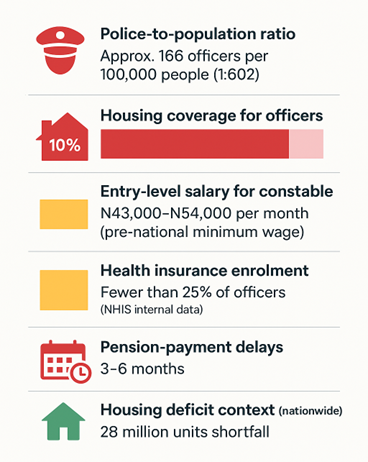
Figure showing Police Welfare Deficit in Numbers (2025)
The Logic of Reform: Linking Welfare to Security Outcomes
A professional police force depends on predictable welfare structures. The welfare–security nexus recognises that decent pay, healthcare, housing, and post-service guarantees are not privileges but conditions for operational efficiency and ethical conduct. Well-compensated officers demonstrate higher morale, greater loyalty, and reduced susceptibility to corruption.
Neglect, on the other hand, fuels rent-seeking behaviour and institutional decay. Welfare reform must therefore be treated as a national security imperative
Comparative Lessons From International Experience
Globally, the connection between welfare and policing outcomes is clear: officer remuneration, benefits, and post-service guarantees directly influence morale, professionalism, and operational effectiveness.
Across the globe, nations are actively reforming their policing systems to fortify security structures and enhance public trust. Nigeria stands to gain valuable lessons from the international experiences highlighted here for policy consideration.
Table 1: Comparative International Experience in Police Welfare Reform.
|
Country |
Core Reform Strategy |
Key Welfare Features |
Impact/Outcome |
|
South Africa |
Post-Apartheid Reforms linking welfare to accountability. |
Competitive salaries (indexed to inflation), housing/medical benefits, pension entitlements, and collective bargaining via the Safety & Security Sectoral Bargaining Council. |
Strengthened morale and operational reliability. |
|
Kenya |
National Police Service Act (2011) & Independent Commission |
Structured pay scales, comprehensive insurance, housing schemes, pension programmes, and psychological support. Pay is insulated from political influence by the Salaries & Remuneration Commission. |
Reduced politicisation of welfare. |
|
India |
State (e.g., Kerala and Maharashtra) & National-Level Welfare Mechanisms |
Welfare funds, group insurance, housing loans, and medical access. National Seventh Pay Commission raised salaries and institutionalised post-retirement benefits (pensions/healthcare). |
Improved retention and professionalism |
|
United Kingdom |
Statutory regulations and independent review bodies |
Structured pensions (Police Pension Regulation 2015), healthcare, life insurance, and career-linked professional development. Independent remuneration review bodies ensure fairness. |
Enhanced professionalism and public confidence |
The examples collectively demonstrate that a successful path to police reform involves:
● Independent oversight to ensure fairness and shield pay/benefits from political manipulation.
● Comprehensive benefits beyond basic pay to include structured pensions, housing support, and healthcare/insurance.
● Institutional integration that entails embedding welfare as a right and linking it directly to accountability and professional development.
Nigeria can strengthen its police system by adapting these lessons to its institutional realities.
Policy Option: The Welfare–Security Nexus Framework (WSNF)
To address persistent welfare gaps that undermine the morale and operational efficiency of the Nigeria Police Force, this policy brief proposes the Welfare–Security Nexus Framework (WSNF).
The WSNF is an integrated, four-pillar reform structure that places welfare at the core of Nigeria’s internal security transformation.
Pillar 1: Constitutional Autonomy and Fiscal Sustainability
Objective: Guarantee predictable, depoliticised funding for police welfare.
Policy Measures:
● Amend the Police Act 2020 to entrench minimum remuneration thresholds and inflation-indexed salary reviews.
● Establish an Independent Police Welfare and Remuneration Commission (IPWRC) to depoliticise salary decisions.
● Ring-fence welfare allocations (salaries, pensions, housing, healthcare) in the consolidated revenue fund.
Pillar 2: Comprehensive Welfare and Post-Service Guarantees
Objective: Build a lifetime welfare ecosystem for officers and families.
Policy Measures:
● Launch a National Police Housing and Mortgage Scheme through NPTF–private partnerships.
● Expand health and insurance coverage to 100% enrolment by 2030.
● Introduce portable pensions, retraining, and reintegration packages for retirees.
● Establish a Police Welfare Fund for scholarships, emergency support, and family benefits.
● Embeds gender-sensitive welfare standards—maternity protection, childcare, equitable promotion—and disability-inclusive housing. Post-service protection for widows and dependants is a statutory component of the Welfare Fund.
Pillar 3: Professional Development and Ethical Leadership
Objective: Tie welfare benefits to competence and ethical performance.
Policy Measures:
● Institutionalise continuous training and leadership programmes via NIPSS and accredited universities.
● Link benefit progression to professional conduct and ethics.
● Establish psychological and stress-management units to improve well-being.
Pillar 4: Accountability, Oversight and Incentives
Objective: Institutionalise transparency and performance-based incentives.
Policy Measures:
● Create a police ombudsman to audit welfare delivery and pension disbursement.
● Publish public performance dashboards tracking welfare access and operational results.
● Reward integrity and unit performance through merit-based grants and sanctions for mismanagement.
Implementation Roadmap for WSNF (2025–2030)
The phased plan balances urgency with fiscal realism, allowing reforms to take root without destabilising existing security operations.
|
Phase |
Timeline |
Key Actions |
Lead Actors |
|
Phase I: Stabilisation |
2025-2026 |
Approve IPWR Bill; conduct a comprehensive welfare audit; implement immediate salary and pension adjustments. |
National Assembly; Ministry of Police Affairs, NPF |
|
Phase II: Expansion |
2026-2028 |
Roll out National Police Housing and Health Schemes; launch Police Welfare Fund; introduce professional-development incentives and mental health programmes |
NPTF; Ministry of Finance; IPWRC |
|
Phase III: Consolidation |
2028-2030 |
Operationalise Police Ombudsman; establish public performance dashboards; integrate welfare metrics into policing evaluation systems |
NPF; civil society; Office of Auditor-General |
Monitoring and Evaluation Framework
To ensure transparency and measure progress, there should be standard key performance indicators (KPIs) to guide implementation. Subsequent quarterly reporting by the Independent Police Welfare and Remuneration Commission and the police ombudsman will institutionalise accountability and public oversight.
Table 4: Monitoring and Evaluation Framework (KPIs)
|
Indicator |
Metric |
Target (2030) |
Data Source |
Reporting Frequency |
|
Welfare Access |
Percentage of officers receiving timely salaries, pensions and health coverage |
100% |
IPWRC Quarterly Report |
Quarterly |
|
Housing Coverage |
Proportion of officers living under official or subsidised housing scheme |
50% |
NPTF Housing Survey |
Annually |
|
Morale and Integrity Index |
Annual survey-based index measuring job satisfaction, ethics and corruption incidence |
75% threshold |
NPF Internal Audit |
Annually |
|
Operational Efficiency |
Response times, cases resolution rates and clearance rates linked to welfare improvements |
+30% improvement |
Police Service Report |
Annually |
|
Public Trust Index |
Citizen-perception surveys conducted annually to assess confidence in the police |
+20% improvement |
Public Affairs Survey |
Annually |
These indicators should be visualised in annual public dashboards, modelled after the UK’s Police Performance Framework, to allow citizen oversight and strengthen institutional accountability.
Policy Alignment and Coherence
The WSNF aligns with Nigeria’s National Security Strategy (2019), National Development Plan (2021–2025), and the AU Framework on Security Sector Reform (2022). It reinforces SDG 16 (Peace, Justice, and Strong Institutions) and supports the broader Decade of Police Reform (2020–2030) initiative. Embedding police welfare reform within these policy frameworks ensures coherence with national and continental priorities, enhancing donor engagement and policy continuity.
Policy Recommendations
For the effective transformation of the Nigeria Police Force under the WSNF, the following recommendations are proposed:
-
Institutionalise welfare autonomy and fiscal safeguards: Amend the Police Act 2020 to entrench welfare rights and automatic pay review.
-
Establish independent oversight: Operationalise IPWRC and the Police Ombudsman.
-
Expand post-service guarantees: Launch housing, health, and pension continuity schemes.
-
Link welfare to professional development: Integrate welfare incentives with ethics and leadership performance.
-
Implement transparent, gender-inclusive monitoring: Use public dashboards and gender-disaggregated welfare data.
Conclusion
The welfare–security nexus is the moral and operational foundation of policing reform. A poorly paid, ill-housed, and uninsured police force cannot safeguard a modern state. Welfare neglect corrodes integrity, weakens command, and feeds the cycle of mistrust between citizens and the state.
Comparative evidence from South Africa, Kenya, India, and the United Kingdom shows that welfare reform produces tangible dividends: better morale, ethical conduct, and operational excellence. Nigeria must therefore treat police welfare not as expenditure but as investment—one that strengthens democracy, restores public confidence, and anchors lasting peace.
A nation cannot secure its citizens with a demoralised force. The path to a stable Nigeria lies through dignity, fairness, and institutional care for those entrusted with the public peace.