
01. Introduction: Nigeria’s Road Safety Crisis
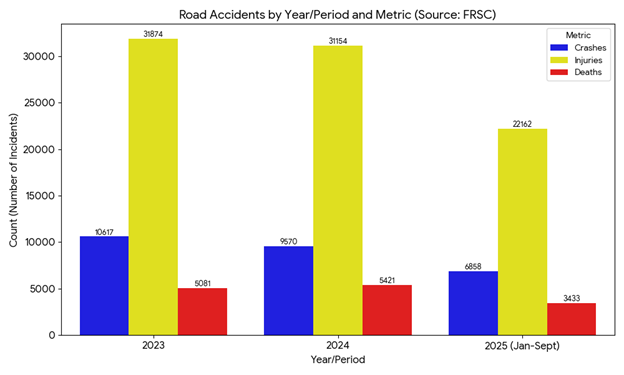
Nigeria faces a persistent road-safety challenge whose scale is insufficiently recognised in national policy discourse. In 2024, the Federal Road Safety Corps (FRSC) recorded 5,421 fatalities from road traffic crashes. The figure reflects more than a statistical trend; it points to a systemic public-safety failure that continues to impose significant social and economic costs.
The consequences reach beyond individual households. Loss of income earners, prolonged disability, and localised economic disruptions collectively diminish productivity and strain community resilience. Yet, the policy response remains fragmented, and implementation has not kept pace with the magnitude of the problem. The risk is unevenly distributed, with fatalities concentrated along specific corridors and among particular vehicle categories, suggesting identifiable structural drivers rather than random variation.
This brief argues that without a coordinated, data-driven strategy, Nigeria’s road crash burden will continue to undermine development outcomes and impose avoidable fiscal and social costs.
The Global Context
Road traffic fatalities constitute a major global public-health challenge. The World Health Organization (WHO) estimates that more than 1.3 million people die annually from road crashes worldwide, with low- and middle-income countries, especially in Africa, carrying a disproportionate share of the burden.
Nigeria remains a particularly high-risk environment. Recent estimates place the country’s mortality rate at 21.4 deaths per 100,000 people, among the highest in Africa. This elevated rate reflects both infrastructural and behavioural risks, but it also highlights an important methodological issue: persistent discrepancies between international modelling and national administrative data.
WHO’s global estimates rely on statistical models that facilitate cross-country comparison. In contrast, FRSC compiles administrative records from hospitals, police units, and its field commands, generating more granular, corridor-level insights. These datasets do not always align, but they serve different purposes. While WHO modelling allows Nigeria to benchmark itself globally, FRSC’s administrative data offers the operational detail required for targeted intervention and resource allocation—information essential for a more effective national response.
What the Data Show
1. Rising fatalities despite fewer crashes
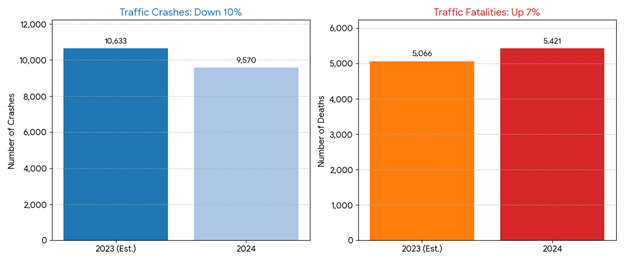
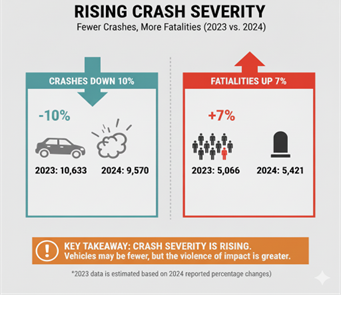
● 2024: 9,570 crashes (down 10%)
2024: 5,421 deaths (up 7%)
Crash severity is rising. Vehicles may be fewer, but the violence of impact is greater.
2. 2025 trends confirm the pattern
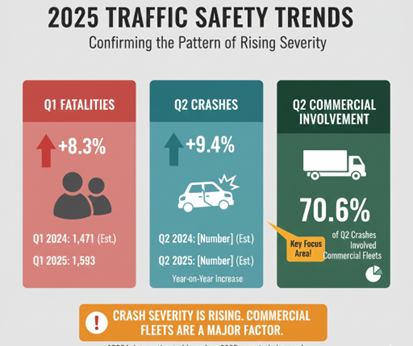
● Q1 2025: 1,593 deaths—8.3% higher than Q1 2024
● Q2 2025: crashes up 9.4% year-on-year
● Commercial fleets involved in 70.6% of Q2 crashes
3. Geography of risk
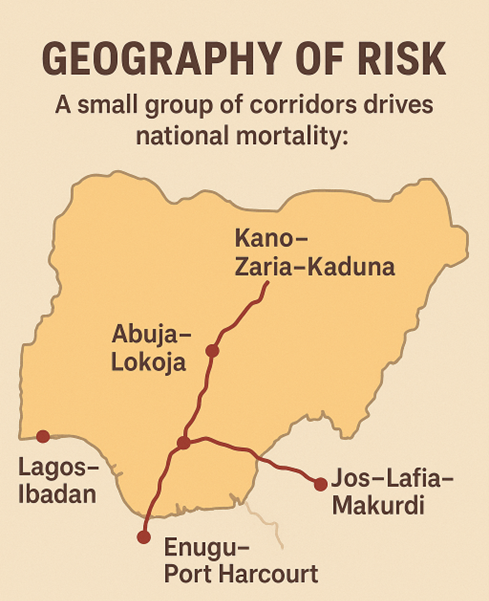
A small group of corridors drives national mortality:
● Lagos–Ibadan
● Abuja–Lokoja
● Kano–Zaria–Kaduna
● Enugu–Port Harcourt
● Jos–Lafia–Makurdi
These routes are the nation’s arteries—and its deadliest fault lines—and should be logical priorities for targeted safety interventions.
4. Long-term evidence is sobering
Between 2016 and 2021, a record number of 32,617 Nigerians died on the roads. The crisis is not new; it is entrenched. These long-term trends underscore the need for systemic reform instead of piecemeal interventions.
The Core Problem: Weak Regulation of Commercial Fleets
Commercial vehicles comprising large buses and freight trucks remain the most dangerous actors on Nigerian roads. In Q2 2025, commercial vehicles were involved in 70.6 per cent of all crashes. Overloading, speeding, driver fatigue, poor maintenance, and weak compliance with the Road Transport Safety Standardisation Scheme (RTSSS) have turned commercial corridors into corridors of grief. The RTSSS mandates fleet certification, driver re-certification, and maintenance checks. Without strict fleet oversight, no road-safety reform will endure.
02. Comparative Perspective: What Other Countries Teach Us
Nigeria’s reform path is neither obscure nor experimental; the successes of peer nations show what works when discipline, data, and design converge. The following cases offer tested models that Nigeria can adapt with precision rather than improvisation.
South Africa
Action: South Africa combined visible, high-frequency enforcement—speed checks, seat-belt verification, and automated camera systems—with focused pedestrian-safety measures along high-risk urban corridors. Seasonal campaigns during festive periods complemented these efforts, while national coordination and reporting were strengthened through RTMC and SANRAL.
Outcome: Where enforcement, engineering, and credible data were applied consistently—at both corridor and seasonal levels—fatalities declined sharply. Prioritising the safety of vulnerable users, particularly pedestrians, accelerated these gains.
Lesson for Nigeria: Deploy camera-based speed enforcement and modern corridor engineering, and anchor both to a transparent national crash-data dashboard updated in real time.
Kenya
Action: Through the NTSA, Kenya launched a time-bound National Road Safety Action Plan (2024–2028), supported by WHO/Bloomberg. They invested in speed management, commercial-fleet reforms, strengthened vehicle inspection, iRAP-based risk mapping, county-level safety committees, digital enforcement, and improved post-crash care.
Outcome: A clear national strategy with measurable milestones increased donor confidence, attracted private funding, and created a shared framework for national and county governments.
Lesson for Nigeria: Establish a national action plan with explicit targets and timelines to unlock financing and enforce responsibility across agencies — particularly in regulating commercial transport.
India
Action: The Motor Vehicles (Amendment) Act 2019 stiffened penalties, raised safety standards, enabled digital enforcement, and improved the regulatory environment. Parallel investments upgraded highways, strengthened emergency and trauma systems, and expanded national and state-level crash reporting.
Outcome: Legal reform improved enforcement credibility, but its full effect emerged only when paired with systemic investment in data and emergency medical care.
Lesson for Nigeria: Legal changes must be accompanied by serious funding for EMS, trauma systems, and digital crash reporting to ensure that enforcement reforms translate into lives saved.
Brazil
Action: Under PNATRANS, Brazil committed to halving traffic deaths by 2030. National policies pushed municipalities to redesign streets for safety, emphasising speed control and protective infrastructure for pedestrians and motorcyclists. São Paulo advanced further by applying iRAP methodologies to assess and prioritise road upgrades.
Outcome: National targets, backed by local implementation and financing for safer street design, led to measurable reductions in urban road deaths.
Lesson for Nigeria: Federal funding criteria should require states and cities to incorporate safer crosswalks, medians, traffic-calming features, and protective urban design into every publicly funded road project.
Taken together, these examples show that durable progress hinges on three constants: credible enforcement, data-driven planning, and infrastructure designed for human survival. Nigeria can move swiftly if it aligns national ambition with corridor-level action.
Cross-cutting lessons for Nigeria:
-
Protect safety budgets within road-building contracts. Brazil’s and South Africa’s success shows the value of embedding safety investments (cameras, ambulances, and enforcement) into infrastructure budgets
-
Regulate commercial fleets through certification, inspections, and tachographs. Kenya and India demonstrate how certification, tachographs, driver certification, and inspections can curb dangerous fleet behaviours. Nigeria should scale its RTSSS and create a national digital fleet registry.
-
Target the deadliest corridors with engineering, cameras, and EMS, a model used in Brazil and South Africa with strong mortality reductions.
-
Build trauma systems that save lives in the first “golden hour”. India and Brazil’s post-crash care strategies underscore the lifesaving benefits of ambulance staging, trauma centre development, and fast referral chains.
-
Strengthen data transparency with a national crash dashboard. Transparent, geocoded crash dashboards and clearly defined national targets (e.g., halve fatalities by 2030) — like those used in Kenya and Brazil — can drive accountability and focused action.
03. Policy Implications for Nigeria’s Road Safety Reform
Nigeria’s road-safety problem is not a shortage of policy commitments but a deficit of strategic focus. Data and global evidence point to three priority implications for reform:
-
Targeted interventions work better than nationwide generalisation.
Countries that concentrate resources on specific risks, corridors, and behaviours achieve faster and more durable reductions in fatalities
-
Commercial fleets must be brought under firm regulatory control. Unchecked fleets undermine national safety goals; nations that tightened certification, inspection, and compliance regimes saw measurable improvements in both crash frequency and severity.
-
Corridor-based enforcement saves the most lives, fastest.
Where enforcement, engineering, and emergency response were aligned along high-risk routes, mortality dropped sharply and predictably.
Nigeria’s response must reflect these realities. A focused, data-driven approach — anchored in regulated fleets, high-risk corridor interventions, and measurable national targets — offers the surest path to reversing the country’s road-safety crisis
Economic Case for Action: The Cost of Inaction
Failing to address road safety is not only a humanitarian lapse but also a costly economic mistake. Road crashes impose a heavy burden on Nigeria through lost productivity, long-term disability, medical expenditures, emergency response, and damage to infrastructure. Estimates consistently show that these losses consume a meaningful share of national GDP — a silent but persistent drag on growth.
Investing in road safety, particularly through a structured six-pillar approach, offers a strong economic return. Fewer fatalities, fewer injuries, and reduced congestion translate directly into higher productivity and lower public and private spending on avoidable crises. A dedicated safety fund, even of a modest size, can unlock significant national value when strategically deployed toward EMS expansion, safe-corridor engineering, automated enforcement, and commercial-fleet regulation.
In short, the economics align with the ethics: investing in safety strengthens both human capital and national competitiveness.
Putting Victims at the Centre of Road Safety Reform in Nigeria
The World Day of Remembrance for Road Traffic Victims underscores the human cost behind the statistics. Commemoration alone cannot drive meaningful change. A victim-centred policy framework provides a structured pathway to convert public empathy into systemic reform. Nigeria’s urgent imperative to address one of its most persistent public-safety crises can be advanced through the following targeted measures:
1. Survivor Support and Trauma Care: Reframing Post-Crash Response as State Capacity
Nigeria needs a national framework that provides survivors and families with comprehensive support: well-equipped trauma centres, accessible psychosocial services, rehabilitation pathways, and legal assistance. These are not welfare add-ons; they are essential components of a humane safety system.
2. Justice and Accountability: Confronting Impunity in the Transport Sector
Strengthened laws — and credible enforcement — are necessary to hold transport operators, fleet owners, and drivers accountable for unsafe practices. Victims’ rights must be protected through transparent investigations, timely prosecutions, and consistent sanctions that deter negligence.
3. Advocacy and Community Engagement: Harnessing Lived Experience for Policy Design
Crash survivors and bereaved families are powerful advocates for change. Nigeria should cultivate structured platforms for their voices—including partnerships with survivor networks and regional initiatives such as the International Road Crash Victims’ African Conference—to ensure policy reflects lived experience.
4. Building a Prevention Culture: Embedding Safety into Civic Life
Ultimately, prevention must become part of Nigeria’s civic identity. Road safety should be embedded in schools, public education campaigns, professional training, and community norms. When safety becomes a shared value rather than a regulatory afterthought, enduring progress becomes possible.
04. Policy Option: National Safe Corridors & Fleet Reform (NSC-FR), 2026–2030
Global experience unequivocally showed that well-designed safe-corridor programmes consistently cut fatalities by 30–50%. When enforcement, engineering, and speed management are synchronised along a defined route, the results are rapid and measurable. For Nigeria, applying this model to its six deadliest corridors offers one of the most realistic and high-impact pathways to immediate fatality reduction.
Strategic Pillars and Action Plan
1. Financing & Procurement: Ring-fenced Safety Investment
Create a dedicated financing stream to ensure that safety is built into every kilometre of new or rehabilitated road.
● Ring-fence 3% of federal and 1.5% of state road-construction budgets for safety measures.
● Fund cameras, ambulances, patrol vehicles, signage, and trauma-care upgrades.
Timeline: pilot within 12 months; scale-up in 1–4 years.
KPIs: share of contracts with safety allocations; funds disbursed; amount allocated to priority corridors.
Risk & Mitigation: Political resistance — counter through demonstration projects and donor matching schemes that show visible returns.
2. Safe Corridors Programme: Engineering and Enforcement
Focus resources on Nigeria’s six most dangerous corridors, where mortality reductions will be fastest and most measurable.
● Retrofit priority corridors with median barriers, rumble strips, pedestrian infrastructure, and improved signage.
● Deploy speed cameras, tow trucks, and rapid-response patrols.
Timeline: diagnostics in 0–18 months; full upgrades in 18–48 months.
KPIs: fatalities per 100 km; average response times; crash reduction.
Evaluation: Monthly corridor dashboards; independent impact evaluation after two years.
Risk & Mitigation: Maintenance failures – Make maintenance a contractual requirement, tracked via digital dashboards.
3. Fleet Reform (RTSSS Scale-Up)
Modernise and enforce oversight of commercial transport — the country’s highest-risk segment.
● Register all commercial fleets in a national digital registry.
● Enforce annual vehicle certification, periodic driver recertification, and mandatory digital tachographs.
● Incentivise compliance with reduced insurance premiums and regulated route access.
Timeline: registry in year 1; full enforcement in years 2–4.
KPIs: fleet registration rate; roadside compliance.
Risk & Mitigation: Informal operators evade regulation — counter through route-permit systems, weigh stations, and targeted enforcement.
4. Emergency Medical Services & Trauma Care
Build a trauma-care network capable of saving lives within the critical “golden hour.”
● Stage ambulances approximately every 50 km along federal highways.
● Upgrade district hospitals into trauma hubs with surgical capacity.
● Deploy a national GPS-enabled EMS dispatch system.
Timeline: pilot in 0–18 months; scale in 18–48 months.
KPIs: time-to-first-medical-contact; survival rates; % of crash sites with ambulance response.
Risk & Mitigation: High capital cost — leverage PPPs and the ring-fenced safety fund to reduce burden.
5. Data, Transparency & Accountability
Make crash data a public good that drives targeted action and creates institutional pressure.
● Launch a national geocoded crash dashboard linking FRSC, hospitals, and police records.
● Standardise reporting and audit data quality through independent verification.
● Adopt measurable targets — including halving fatalities on priority corridors by 2030.
Timeline: beta within 12 months; full rollout in 12–36 months.
KPIs: Data completeness, reporting lag, and public use.
Risk & Mitigation: Data silos—address via inter-agency MOU and legal mandate for sharing.
6. Behaviour Change & Enforcement
Shift norms and strengthen enforcement to reduce high-risk behaviours.
● Integrate road-safety education into school curricula.
● Expand driver testing, digital licensing, and automated enforcement on priority corridors.
● Run nationwide campaigns on speed reduction, drink-driving, helmet and seatbelt use, and overloading.
Timeline: 0–24 months for education and media; 24–48 months for digital licensing and camera rollout.
KPIs: speed compliance; helmet and seatbelt usage rates; test pass rates.
Risk & Mitigation: Public resistance to automated enforcement — ensure transparency of revenue and reinvest all proceeds in safety.
7. Governance
Anchor the reform in high-level political commitment and sustained oversight.
● Establish a National Road Safety Steering Committee (presidential level).
● Implement quarterly KPI reporting, annual independent evaluation and a 36-month mid-term review for adaptive reforms.
● Create an oversight board for the ring-fenced safety fund.
05. Key Recommendation
To achieve meaningful and sustainable improvements in road safety across Nigeria, the following policy measures are recommended:
-
Legislate ring-fenced road-safety funding across all federal and state road projects.
-
Implement safe-corridor upgrades on the six deadliest highways.
-
Fully digitalise and enforce the RTSSS, ensuring commercial fleet accountability.
-
Expand EMS and trauma-care capacity along major routes.
-
Launch a transparent national crash dashboard to sharpen accountability.
-
Invest in behaviour change, enforcement, and driver education to rebuild Nigeria’s road-safety culture.
06. Conclusion: A Moment for Resolve
Nigeria stands on the edge of a stark choice. The current path leads to more funerals, more economic loss, and another wasted decade. The alternative — disciplined investment, targeted enforcement, stronger institutions, and honest data — offers a future where remembrance is not merely mourning but a pledge fulfilled.
The country has the knowledge, the evidence, and the tools. What remains is the will. The time to act is now, before another year carves fresh names into the nation’s ledger of avoidable loss.