
Defining the Problem: Governance Failures in Medicine Quality
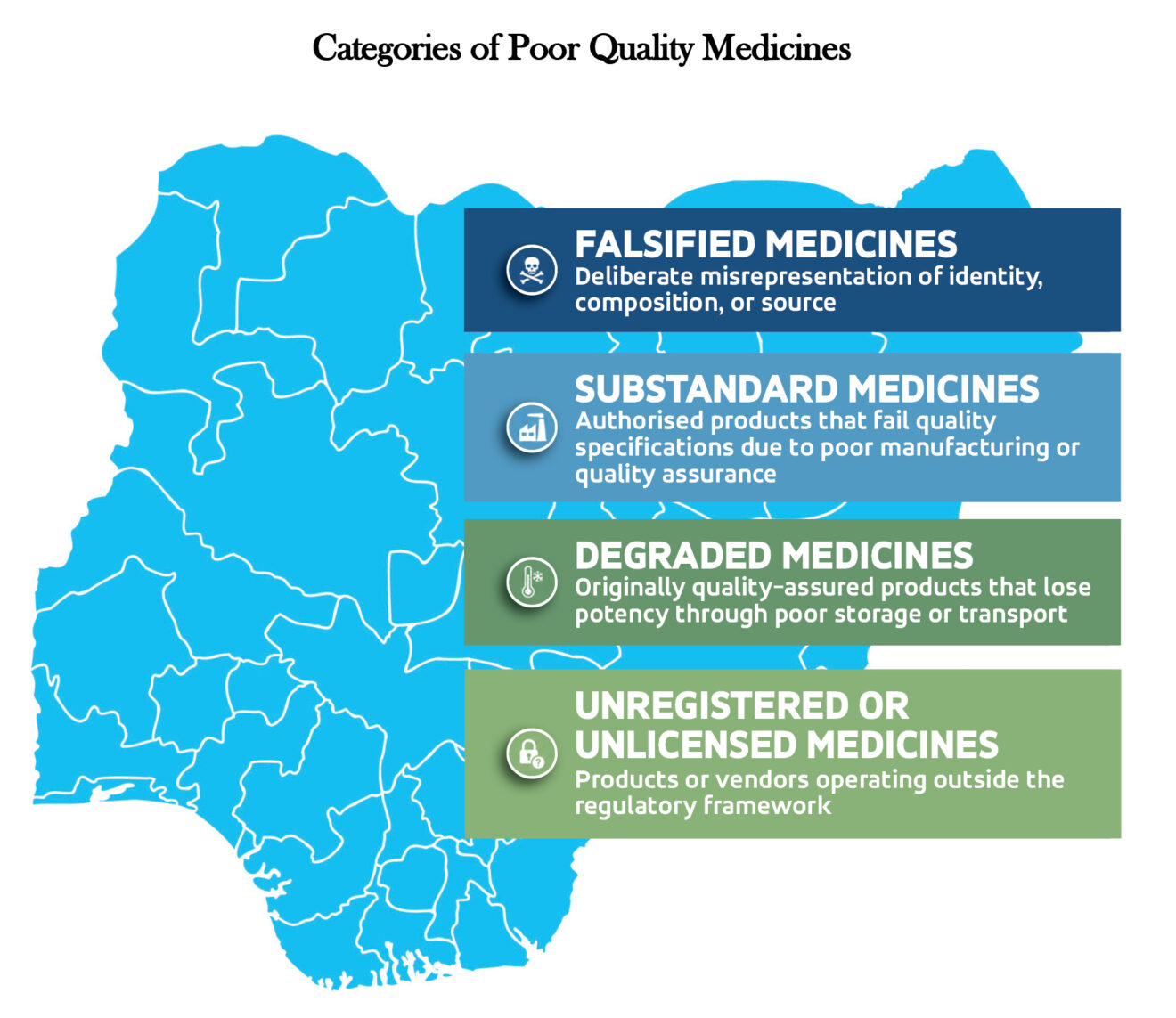
Effective regulation begins with conceptual clarity. Nigeria’s medicine-quality crisis is frequently treated as a single phenomenon, yet it comprises distinct failure modes, each demanding a different policy response. Using the WHO framework, this brief aligns categories of poor-quality medicines with their primary regulatory levers as follows:
Falsified medicines: Deliberate misrepresentation of identity, composition, or source. Primary failure: organised criminal activity. Policy levers: intelligence-led enforcement, supply-chain traceability, border controls, and criminal prosecution.
Substandard medicines: Authorised products that fail quality specifications due to poor manufacturing or quality assurance. Primary failure: weak Good Manufacturing Practice (GMP) compliance. Policy levers: factory audits, sanctions, and manufacturer upgrading.
Degraded medicines: Originally quality-assured products that lose potency through poor storage or transport. Primary failure: weak Good Distribution Practice (GDP) and cold-chain enforcement. Policy levers: licensed wholesale tiers, temperature-controlled logistics, and storage inspections.
Unregistered or unlicensed medicines: Products or vendors operating outside the regulatory framework. Primary failure: market-entry and compliance failure. Policy levers: registration enforcement, licensing sanctions, and market surveillance.
Nigeria’s most persistent failures are concentrated in distribution and storage, not solely in falsification or manufacturing.
Distribution and Storage: The Central Vulnerability
Falsified and substandard drugs have persisted as one of Nigeria’s most alarming public health challenges, undermining healthcare delivery and eroding trust in the pharmaceutical system.
The problem dates back to the late 1970s and 1980s when weak regulation, porous borders, and import dependence allowed counterfeit medicines to flood the Nigerian market. By the early 2000s, reports indicated that over 40 per cent of drugs circulating in Nigeria were fake or substandard, with up to 70 per cent being unregistered.
Although the establishment of the National Agency for Food and Drug Administration and Control (NAFDAC) in 1993 marked a significant policy response, the persistence of open drug markets remains Nigeria’s central regulatory challenge. Unlicensed vendors and unregulated environments in Lagos, Onitsha, Kano, and other hubs continue to facilitate the circulation of poor-quality medicines.
Implementation of the National Drug Distribution Guidelines (NDDG), particularly the relocation of open markets into CWCs, has stalled due to trader resistance, fragmented authority, and weak political backing.
Furthermore, Nigeria’s overdependence on imported pharmaceuticals from Asia, particularly India and China, complicates the regulatory process since many products arrive without proper registration or verification of source authenticity.
Storage and distribution issues further exacerbate the problem. Even when medicines are genuine, poor handling and temperature fluctuations often compromise their quality. For example, a NAFDAC study found that up to 74 per cent of oxytocin samples fail stability tests due to improper storage and distribution practices.
Weak implementation of national policies such as the National Drug Policy (NDP) and NDDG also limits progress. While these policies provide frameworks for manufacturing standards and drug distribution, enforcement has been inconsistent, largely due to poor funding, inadequate staffing, and corruption within regulatory agencies.
Evidence on Substandard and Falsified Medicines in Nigeria
Claims about the prevalence of SF medicines in Nigeria require careful contextualisation. While estimates from the late 1990s and early 2000s suggested extremely high prevalence, current risks are uneven across drug classes and supply chains.
To improve analytical credibility, this brief organises evidence into a Nigeria-specific hierarchy of reliability:
-
Regulatory seizure, recall, and destruction data (high confidence): NAFDAC alerts and port seizures consistently identify recurrent pressure points and products.
-
Sentinel sampling studies (moderate–high confidence): Drug-specific studies—particularly on antimalarials, oxytocin, and antibiotics—show persistent failure rates linked largely to storage and distribution.
-
Facility inspection outcomes (moderate confidence): GMP and GDP inspections reveal uneven compliance, especially among import-dependent distributors and informal wholesale hubs.
-
Border interception data (moderate confidence): Joint Customs–NAFDAC operations highlight vulnerabilities at ports and land borders, though public datasets remain incomplete.
-
Market surveys and consumer studies (lower confidence): Useful for understanding risk perception but insufficient for prevalence estimation.
While overall prevalence may have declined since its historic peak, structural vulnerabilities, especially in informal wholesale distribution, remain acute.
Political-Economic Drivers of Open Drug Markets
Open drug markets endure not because of regulatory ignorance, but because they are embedded political–economic systems. These markets provide livelihoods for thousands, generate rents for intermediaries, and often operate under informal protection from local power structures.
Reform efforts have faltered due to trader resistance driven by fear of income loss, fragmented state–federal authority, weak compensation or relocation frameworks, and inconsistent political backing.
Effective reform must therefore combine coercive regulation with negotiated transition, including phased relocation to coordinated wholesale centres, temporary licensing pathways, financial or logistical support for compliant traders, and public accountability for persistent non-compliance.
Public Health and Socioeconomic Impacts
Substandard and falsified medicines impose significant socio-economic and public health costs in Nigeria. Patients frequently suffer prolonged illness, treatment failure, or, in severe cases, death. Counterfeit antimalarials and antibiotics exacerbate antimicrobial resistance, amplifying long-term health risks and undermining disease control efforts.
The economic toll is substantial. Ineffective treatments necessitate repeated care, resulting in annual losses amounting to billions of naira.
Beyond financial costs, public trust in the healthcare system and in regulatory institutions—most notably NAFDAC and the Pharmacy Council of Nigeria (PCN)—has been undermined.
Psychologically, uncertainty over medicine authenticity generates anxiety among patients and health professionals alike, reducing adherence to prescribed treatment protocols and further compromising health outcomes.
The cumulative effect is a vicious cycle: diminished confidence fuels informal purchasing channels, which in turn perpetuate the circulation of poor-quality medicines.
Regulatory Landscape and Institutional Gaps
Nigeria’s drug regulatory ecosystem is fragmented across multiple institutions with overlapping mandates:
NAFDAC: Product registration, GMP inspection, post-market surveillance, recalls, and border collaboration.
Pharmacy Council of Nigeria (PCN): Licensing and regulation of pharmacies and patent medicine vendors.
Nigeria Customs Service: Import control at ports and borders.
Standards Organisation of Nigeria: Product standards and conformity assessment.
Law enforcement agencies (e.g., NDLEA): Criminal investigation where medicines intersect with organised crime.
State Task Forces: Market-level enforcement with variable capacity.
Although legal tools exist under the NAFDAC Act, PCN Act, and National Drug Distribution Guidelines, accountability weakens at institutional hand-offs, particularly between import clearance and wholesale distribution.
Hence, key gaps persist at ports and bonded warehouses, informal wholesale markets, secondary distribution chains, patent medicine vendor oversight, and online and cross-border trade.
International Experience: Lessons for Nigeria
International experience underscores that no single intervention is sufficient. Looking at other countries helps to see what works, what does not, and what might be adapted.
European Union: The Falsified Medicines Directive mandates safety features on medicinal packaging (e.g., unique identifiers, tamper-evidence), strict wholesale licensing, inspections, and end-to-end traceability. This has raised the bar on anti-counterfeit regulation across EU member states.
Southeast Asia: Countries such as Cambodia, Thailand and Vietnam combine outlet licensing, inspections, and public awareness, though weak sanctions and judicial follow-through persist.
Tanzania: Tanzania’s post-market surveillance, sentinel sampling, and community education around drug purchase sources show promise but face resource constraints, corruption, and supply chain issues.
India: Some states in India have strengthened regulation of active pharmaceutical ingredients (APIs), mandated GMP, and improved sampling and enforcement through stricter import control, though counterfeit medicines are still a problem. Global reviews note that weak regulatory oversight, corruption, and supply chain complexity are common risk factors.
The common lesson is clear: durable progress requires coordinated legal, technological, and institutional reforms.
Policy Options: Strengthening Distribution Governance and Enforcement
The policy options outlined below are designed to close the regulatory, market, and institutional gaps identified earlier. Rather than introducing new laws or agencies, they focus on strengthening, sequencing, and enforcing existing frameworks. The emphasis is on feasibility, institutional incentives, and political economy. Each option is paired with an indicative implementation horizon to signal urgency and prioritisation.
Option 1: Deterrence and Accountability Reform (0–12 months)
Objective: Raise the cost of non-compliance to a level that credibly deters the manufacture, importation, and distribution of substandard and falsified medicines.
Near-term actions (0–6 months):
● Review and operationalise penalty provisions under existing statutes (NAFDAC Act, PCN Act, National Drug Policy) to ensure that violations attract sanctions proportionate to public-health risk, including substantial fines, licence suspension or revocation, asset forfeiture, and criminal prosecution.
● Issue prosecutorial guidelines clarifying admissible regulatory evidence, including sampling protocols, laboratory results, and seizure documentation.
● Establish dedicated drug-offense desks or fast-track procedures within relevant courts to reduce delays and case attrition.
Medium-term actions (6–12 months):
● Implement targeted capacity-building programmes for judges and magistrates on medicine regulation, supply-chain risk, and public-health harm.
● Institutionalise parliamentary oversight through annual hearings and mandatory public reporting by NAFDAC and the Pharmacy Council of Nigeria (PCN).
● Introduce transparency and anti-corruption safeguards in inspections and border control, including audit trails, officer rotation, and whistleblower protections.
Expected outcome: Faster case resolution, reduced regulatory capture, and credible deterrence against non-compliance.
Option 2: Structured Market Transition and Distribution Governance (6–24 months)
Objective: Eliminate high-risk open drug markets and establish a regulated, traceable, and accountable pharmaceutical distribution system.
Transition phase (6–12 months):
● Enforce the National Drug Distribution Guidelines through phased relocation of open drug markets into Coordinated Wholesale Centres (CWCs).
● Begin compulsory licensing and registration of all wholesalers, pharmacies, and patent medicine vendors, supported by publicly accessible registers.
● Publish and enforce minimum Good Distribution Practice (GDP) and Good Storage Practice standards.
Consolidation phase (12–24 months):
● Complete the closure of non-compliant open markets following clearly defined transition deadlines.
● Conduct routine audits of CWCs, wholesalers, and retail outlets.
● Introduce tiered distribution controls that restrict wholesale activities to licensed entities only.
Expected outcome: Reduced circulation of degraded and falsified medicines, improved storage conditions, and clearer accountability across the supply chain.
Option 3: Risk-Based Surveillance and Technology Deployment (6–18 months)
Objective: Improve early detection, monitoring, and rapid response to poor-quality medicines through targeted surveillance and data integration.
Initial actions (6–12 months):
● Expand Mobile Authentication Service (MAS) coverage for high-risk and high-volume medicines.
● Deploy portable screening technologies (such as Raman spectroscopy devices) at ports, markets, and inspection points.
● Strengthen post-market surveillance through routine and sentinel sampling focused on priority drug classes.
System-building actions (12–18 months):
● Establish an integrated national medicines database linking product registration, inspections, recalls, seizures, and border rejections.
● Connect national alert systems with WHO global surveillance platforms.
● Pilot serialisation and track-and-trace systems for selected essential medicines.
Expected outcome: Earlier detection of risks, faster recalls, and more data-driven regulatory action.
Option 4: Quality-Assured Supply Stabilisation (12–36 months)
Objective: Reduce dependence on high-risk imports while strengthening domestic pharmaceutical production and quality.
Supply-side support (12–24 months):
● Provide targeted incentives—including tax reliefs, concessional financing, and grants—for local manufacturers producing essential medicines.
● Support GMP upgrading through technical assistance and regulatory mentoring.
● Tighten import requirements through Drug Master Files, verified foreign manufacturer inspections, and pre-shipment clearance.
Import discipline (24–36 months):
● Restrict pharmaceutical imports to designated, well-equipped ports.
● Institutionalise joint Customs–NAFDAC quality testing of imported consignments.
● Enforce mandatory destruction of non-compliant imports.
Expected outcome: Improved availability of quality-assured medicines and reduced exposure to substandard imports.
Option 5: Demand-Side Protection and Institutional Capacity Building (ongoing)
Objective: Reduce consumer exposure to unsafe medicines while strengthening regulatory and professional capacity.
Immediate actions (0–6 months):
● Launch sustained public awareness campaigns on identifying genuine medicines and avoiding unlicensed vendors.
● Engage market associations, pharmacists, and patent medicine vendors through structured dialogue to support compliance.
Capacity-building actions (6–18 months):
● Expand continuous professional development for regulators, pharmacists, and inspectors.
● Increase and stabilise budgetary allocations to NAFDAC and PCN for laboratories, staffing, logistics, and power supply.
● Institutionalise civil-society monitoring and feedback mechanisms.
Expected outcome: Better-informed consumers, improved compliance, and more resilient regulatory institutions.
Recommendations: Prioritised Actions for Reform
1. Enforce a time-bound closure of open drug markets through phased transition
Timeline: 6–24 months
Lead institutions: NAFDAC, PCN, and state governments.
Government should implement a non-negotiable, phased closure of open drug markets under the National Drug Distribution Guidelines, coupled with relocation to CWCs. A uniform national timetable, backed by conditional licensing and sanctions, is essential to prevent regulatory arbitrage. Non-compliant actors should face licence withdrawal, seizure of stock, and prosecution.
Why it works: Targets the single largest structural driver of degraded and falsified medicines—unregulated distribution.
2. Raise the cost of non-compliance through swift prosecution and deterrent penalties
Timeline: 0–12 months
Lead institutions: Ministry of Justice, Judiciary, NAFDAC, National Assembly
Existing laws must be operationalised to impose meaningful penalties, supported by specialised court tracks and trained judges. Parliamentary oversight should require annual enforcement and prosecution reporting.
Why it works: Alters incentives by making illegal trade economically and legally untenable.
3. Institutionalise risk-based surveillance and track-and-trace for priority medicines
Timeline: 6–18 months
Lead institutions: NAFDAC, Ministry of Health, Nigeria Customs Service
Surveillance should prioritise high-risk medicines, such as antimalarials, antibiotics, oxytocin, vaccines, using sentinel sampling, authentication tools, and screening at ports and markets.
Why it works: Enables early intervention before harm reaches patients.
4. Strengthen import controls while accelerating quality-assured local manufacturing
Timeline: 12–36 months
Lead institutions: Ministry of Trade, NAFDAC, Customs, Ministry of Finance
Tighter import discipline must proceed in parallel with incentives and GMP support for domestic manufacturers.
Why it works: Reduces systemic exposure to substandard imports while stabilising supply.
5. Protect consumers and invest in regulatory capacity
Timeline: Ongoing
Lead institutions: Federal and State Governments, NAFDAC, PCN
Sustained public education and predictable regulatory financing are essential to long-term compliance and trust.
Why it works: It shrinks demand for unsafe medicines while strengthening enforcement from within.
Conclusion: Towards a Safer Pharmaceutical System
Nigeria’s struggle with substandard and falsified medicines is fundamentally a distribution governance failure, not a lack of laws or regulatory institutions. While frameworks such as the National Drug Policy and the National Drug Distribution Guidelines exist, weak enforcement at ports, wholesale markets, and storage points continues to allow poor-quality medicines to reach patients. Evidence shows that distribution-related degradation and regulatory evasion now pose greater risks than large-scale counterfeiting alone.
Comparative experience demonstrates that sustainable improvement requires more than enforcement campaigns. Nigeria must combine deterrent penalties with licensed wholesale tiers, cold-chain enforcement, risk-based surveillance, and judicial follow-through.
If implemented in a sequenced and coordinated manner, the reforms outlined in this brief can materially reduce poor-quality medicines, restore confidence in regulation and protect public health.