
Diagnosing Nigeria’s Learning Crisis
Weak Foundational Outcomes
To understand the scale and implications of Nigeria’s learning crisis, it is necessary first to examine foundational literacy and numeracy outcomes among primary school pupils.
Despite improved enrolment rates, learning outcomes remain poor. The 2022 National Assessment of Learning Outcomes reported that only 32% of Primary 3 pupils met literacy benchmarks, and 28% met numeracy benchmarks. Many children in low-income households cannot read age-appropriate texts by age 10. This development reinforces learning poverty and limits future labour-market participation.
Regional and Socio-Economic Disparities
Learning outcomes in Nigeria are not uniform; they vary sharply across regions and socio-economic groups, reflecting underlying inequities in access and resources.
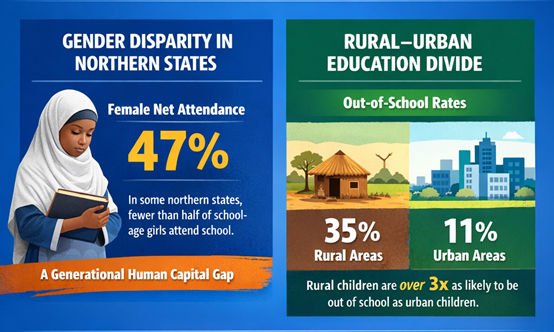
For example, female net attendance in some northern states is as low as 47%. Rural primary out-of-school rates reach 35%, compared with 11% in urban areas. Gender disparities are pronounced in parts of the North West, where literacy outcomes for girls trail those of boys by double-digit percentage points. States with lower per-pupil expenditure (often below N45,000 annually) consistently underperform in literacy and numeracy relative to higher-spending states.
These inequalities are not incidental; they reflect structural differences in fiscal capacity, teacher availability, and local administrative competence. Reform, therefore, must be geographically targeted and fiscally realistic. It should prioritise underserved regions while addressing systemic inequities.
Institutional Misalignment: The Core Problem
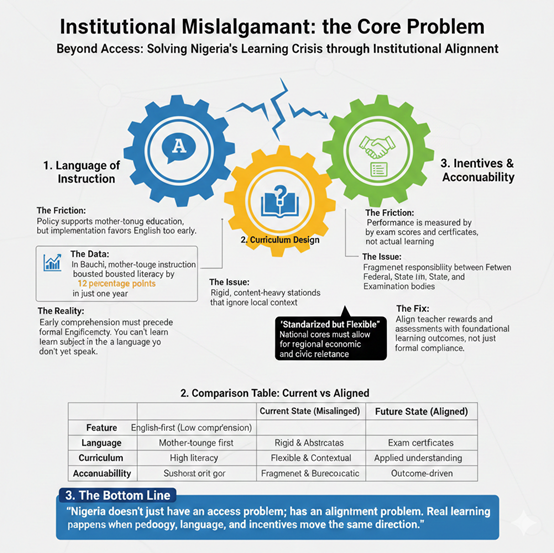
Beyond raw access, systemic misalignments in language policy, curriculum design, and teacher incentives exacerbate Nigeria’s learning crisis. Each of the following institutional constraints plays a critical role in limiting foundational learning.
● Language of Instruction Misalignment
Only a small proportion of early primary pupils receive instruction in a familiar indigenous language, despite policy support for mother-tongue education. Nigeria’s linguistic diversity creates logistical and teacher-training challenges, yet international and local evidence indicates that early instruction in a familiar language significantly improves comprehension.
A quasi-experimental study in Bauchi, for example, found that mother-tongue instruction increased early-grade literacy by 12 percentage points after one academic year. While replication at scale remains limited, the evidence suggests that language alignment is foundational to learning gains. Pragmatically, Early comprehension must precede formal English proficiency.
● Curriculum Rigidity and Limited Local Relevance
Nigeria’s national curricula are standardised and content-heavy.While uniform standards ensure national coherence, they constrain the integration of locally grounded examples and project-based learning. Abstract content often bears little relation to regional economies or civic realities. The result is disengagement and limited application of knowledge.
The reform implication is that core national standards should coexist with structured flexibility for local contextualisation.
● Incentive and Accountability Misalignment
Assessments prioritise examination performance over applied understanding. Teacher incentives are linked more to certification and formal compliance than to classroom-level learning outcomes. Responsibilities are fragmented across federal ministries, curriculum bodies, state boards, and examination authorities.
This misalignment weakens accountability and reinforces exam-oriented instruction. Hence, Pedagogy, assessment, and teacher incentives must be aligned with foundational learning outcomes.
Federalism and Governance Constraints
Structural features of Nigeria’s federal system shape both the opportunities and constraints for effective curriculum reform.
At the federal level, the Federal Ministry of Education and NERDC set curriculum frameworks and standards, while UBEC coordinates funding and monitoring. States, which own and operate the vast majority of public primary schools manage teacher deployment and school operations through SUBEBs and ministries of education. Of the roughly 65,529 public primary schools in Nigeria, only about 104 are federal, with the rest under state authority.
Per-student educational expenditure varies widely across Nigerian states, and overall spending remains low by international standards; states on average spent only N6,981 per student in 2024, and not a single state exceeded N20,000 per person, highlighting sharp disparities in resource allocation and implementation.
In Nigeria’s federal system, curriculum reform is less a technical redesign exercise than a coordination and capacity challenge. Without vertical alignment and state-level ownership, national reforms risk remaining aspirational.
Lessons from Comparable Reform Contexts
Looking abroad, Nigeria can draw lessons from countries that have attempted large-scale curriculum reforms, particularly in contexts with complex governance and diverse student populations.
Table: Key Lessons and Reform Pathways for Addressing Nigeria’s Foundational Learning Crisis
|
Country |
Reform Focus & Highlights |
Key Challenges |
Implementation Outcomes |
Lessons for Nigeria |
|
South Africa |
● Curriculum decolonisation ● African languages ● Revised pedagogy |
Curriculum instability; uneven teacher preparedness, political contestation; administrative complexity |
Mixed outcomes, teacher workload increased |
Reforms without sustained teachers’ capacity-building risk fatigue; political contestation must be anticipated |
|
Kenya |
● Competency-based curriculum ● skills, relevance, & community-linked learning |
Teacher overload; escalating costs; litigation; parental uncertainty |
Some improvement linking learning to skills and livelihood; administrative and fiscal strains allowed rollout |
Link curriculum to skills; sequence reforms; pilot interventions; manage teacher workload and parental expectations |
Although national contexts differ, common structural patterns are evident in teacher capacity, political contestation, and fiscal constraints.
Distilled Lessons for Nigeria
1. Reform fatigue emerges without sustained teacher support.
2. Curriculum instability undermines credibility.
3. Fiscal realism determines durability.
4. Political economy resistance is predictable and manageable with sequencing.
Sequenced Policy Pathways
Based on the diagnosis, this brief proposes three interlinked policy pathways designed to strengthen foundational learning through phased, politically feasible interventions.
Option 1: Early-Grade Language Alignment Pilots
Early-grade language alignment addresses the critical gap in comprehension caused by instruction in unfamiliar languages
Political economy
Rural communities may support such reforms, while urban middle-class parents and private schools may resist due to perceived labour-market advantages of English-medium instruction.
Mitigation
Phased implementation, clear communication of transition plans, and engagement with examination boards.
Key indicators:
Early-grade literacy and numeracy outcomes, pupil engagement, and successful English transition rates.
Estimated cost: N1.5–2 billion per state over three years, including teacher training and materials. This represents a modest fraction of aggregate state education budgets and could be co-financed through UBEC matching grants.
Responsible Institutions: SUBEBs, UBEC
Option 2: Curriculum Relevance and Local Adaptation Framework
Curriculum flexibility enables local contextualisation while maintaining national standards, improving engagement and relevance.
Political economy:
Relatively low resistance, though uptake may vary across states depending on capacity.
Mitigation:
Technical support to lower-capacity states and peer-learning networks.
Key indicators:
Adoption rates of local modules, retention, and student engagement.
Responsible Institutions: NERDC, State Ministries of Education
Option 3: Assessment and Teacher Incentive Alignment
Assessment and teacher incentive reforms align pedagogy with learning outcomes, reinforcing accountability and classroom practice.
Political economy:
Potential resistance from examination bodies and elite schools accustomed to high-stakes testing.
Mitigation:
Pilot non-high-stakes assessment components before full integration.
Key indicators:
Changes in classroom practice, assessment reliability, and teacher participation in aligned professional development.
Responsible Institutions: WAEC, NECO, FME
Fiscal and Feasibility Considerations
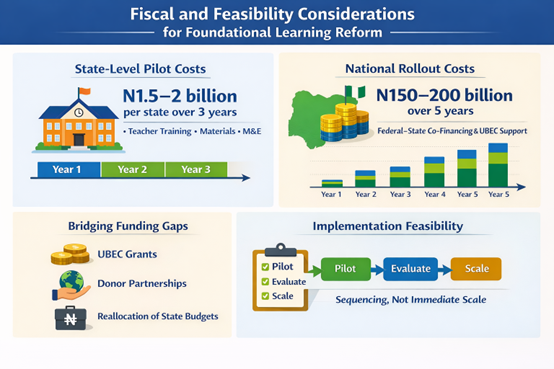
Estimated incremental cost for state-level pilots: N1.5–2 billion per state over three years (including teacher training, instructional materials, and M&E).
National rollout of all three reforms would require approximately N150–200 billion over five years, contingent on federal–state co-financing and UBEC support.
Funding gaps may be addressed via UBEC grants, donor partnerships, and reallocation of existing state education budgets.
Reform feasibility depends on sequencing, not immediate scale.
Recommendation: Implementation Roadmap
To translate the proposed policy pathways into measurable outcomes, implementation must be structured in sequenced phases, balancing pilot testing, capacity building, and national scaling.
1. Reframe reform around literacy, numeracy, and comprehension rather than symbolic curriculum expansion. Establish outcome targets and a communication strategy.
2. Roll out state-led pilots within existing institutional structures. Collect baseline and follow-up data. Use robust monitoring and evaluation to identify bottlenecks and refine implementation.
3. Adjust teacher training, professional development, and assessments to reinforce foundational learning objectives and institutionalise successful pilot components before scaling.
Cross-Cutting Priority: Political Economy Management
Alongside technical reforms, careful attention to political economy dynamics and robust monitoring are essential to secure sustainability and measurable outcomes.
Engage parents, teachers, examination authorities, and private schools from the outset; anticipate potential resistance; cultivate broad coalitions; and pace implementation realistically to prevent reform fatigue.
Monitoring and Scaling Benchmarks
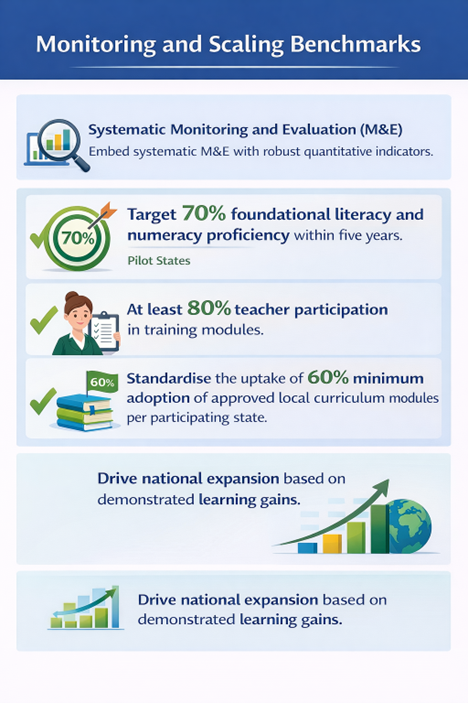
Embed systematic M&E with robust quantitative indicators.
● Target 70% foundational literacy and numeracy proficiency in pilot states within five years.
● At least 80% teacher participation in training modules.
● Standardise the uptake of a minimum 60% adoption of approved local curriculum modules per participating state.
National expansion should follow demonstrated learning gains.
Federal and State responsibilities
Federal Level:
● NERDC/FME: Lead curriculum revision, provide technical support, and set core learning standards.
● UBEC: Coordinate funding, provide M&E frameworks, and track pilot performance.
● WAEC/NECO: Adjust assessment frameworks incrementally; participate in pilot evaluations.
● Policy Communication: Advocate nationally, reduce resistance, and manage stakeholder engagement.
State Level:
● SUBEBs/State Ministries: Execute pilots, adapt curriculum locally, and manage teacher training.
● Schools: Deliver early-grade language instruction, integrate local modules, and participate in monitoring.
● Local Stakeholder Engagement: Parents, community leaders, and local exam authorities.
● Data Collection & Reporting: Track KPIs (literacy, numeracy, engagement, transition outcomes).
Conclusion: From Access to Learning Security
In light of the evidence and lessons presented, Nigeria’s education challenge is no longer access alone; it is learning. Weak foundational outcomes threaten productivity, equity, and long-term growth. The imperative now shifts from expanding access alone to securing foundational learning outcomes for all children.
Yet reform must acknowledge institutional realities. Curriculum redesign without governance alignment will fail. Symbolic reform without teacher support will stall. Sequenced, evidence-driven pilots anchored in state institutions offer a politically feasible path forward.
With disciplined coordination across federal and state actors, Nigeria can move beyond enrolment expansion and secure the foundations of learning for a new generation.