
1. INTRODUCTION: INSTITUTIONAL TRUST AND THE WAEC MANDATE
Public confidence in examination bodies is fundamental to the legitimacy of an education system. Since its establishment in 1952, the West African Examinations Council (WAEC) has served as the region’s foremost examining authority, providing certification recognised by universities and employers alike. In Nigeria, WAEC results determine access to tertiary education and employment. Hence, the examination body serves as both assessor and gatekeeper.
The 2025 West African Senior School Certificate Examination (WASSCE) controversy has, however, raised concerns regarding WAEC’s reliability. The year saw a record decline in performance, technical failures in result release, and public dissatisfaction with the Council’s communication. These problems exposed deep structural weaknesses in result management and governance that, if unaddressed, could corrode institutional trust.
WAEC’s historical reputation was built on standardisation and fairness. Yet persistent examination malpractice, recurrent result withholding, and operational lapses have eroded this legacy. For instance, between 170,000 and 365,000 results have been withheld annually over the past seven years. This reflects weak
Restoring WAEC’s reputation is thus not simply an administrative challenge; it is a moral imperative central to safeguarding the integrity and credibility of Nigeria’s educational system.
2. UNDERSTANDING WAEC’S CREDIBILITY CRISIS
2.1 Dimension of the Crisis
The 2025 WASSCE marked a turning point in WAEC’s integrity challenge. Initially, the Council reported that only 38.32% of candidates obtained five credits, including English and mathematics, the lowest rate in five years. The report triggered public alarm. Within days, WAEC admitted to grading errors caused by misapplied serialisation keys and issued a revised pass rate of 62.96%. Though the correction calmed panic, it exposed a serious failure in result verification and internal quality control.
Operational shortcomings have further exacerbated the problem. Examination papers arrived late at several centres. Some candidates wrote under inadequate lighting and exhausting conditions. The online result portal experienced a prolonged outage, leaving candidates unable to access their results. The incident sparked damaging rumours of incompetence and a potential cover-up.
As in previous years, the routine withholding of results persisted. According to WAEC’s 2025 provisional data, 215,149 candidates had their results withheld pending investigation. This figure aligns with the Council’s historical pattern, which has seen an average of 192,000 results withheld annually since 2014. In 2025, the withheld results account for an estimated 9 to 12 per cent of the total candidature.
Figure: WAEC withheld results (2014–2023)
● 2014: 145,795
● 2015: 118,101
● 2016: 137,295
● 2017: 214,952
● 2018: 10,211
● 2019: 180,205
● 2020: 215,149
● 2021: 170,146
● 2022: 365,564
● 2023: 262,803
● 2024: 215,267
● 2025: 262,803
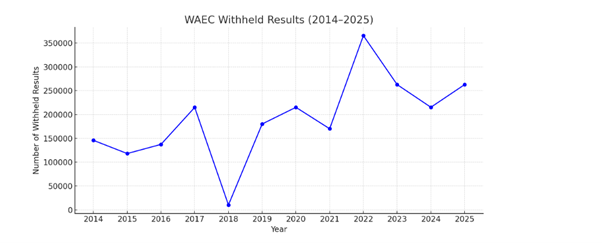
Source: Statisense (2024)
The erosion of WAEC’s credibility has consequences that extend well beyond examination halls. University admissions rely heavily on WAEC certification, and delays or disputed results put thousands of placements at risk each year. In the labour market, employers are increasingly scrutinising the authenticity of certificates, necessitating costly and time-consuming verification processes.
Over time, this erosion of trust undermines the social contract that sustains Nigeria’s merit-based mobility. It deepens inequality between those with access to reliable certification and those left in a state of uncertainty. This situation demands comprehensive reform to restore public confidence and safeguard the integrity of Nigeria’s educational assessment system.
Figure 1: Dimensions of WAEC’s Credibility Crisis.
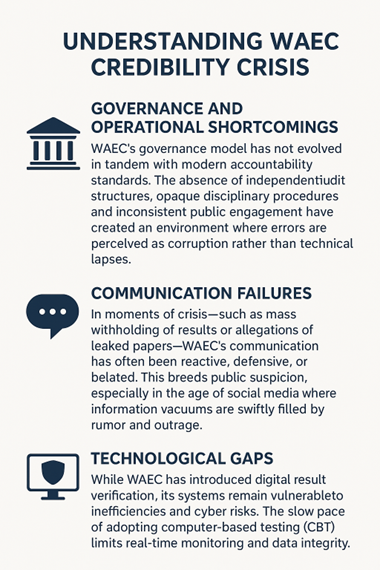
The figure illustrates the interlinking failures in governance, communication, and technology that together erode WAEC’s institutional integrity. Governance weaknesses foster opacity, communication lapses fuel public suspicion, and technological gaps magnify operational risk. Each strand reinforces the other, creating a cycle of mistrust that must be broken through transparent reform.
● Governance and Operational Shortcomings
WAEC’s governance model has not evolved in tandem with modern accountability standards. The absence of independent audit structures, opaque disciplinary procedures, and inconsistent public engagement have created an environment where errors are perceived as corruption rather than technical lapses.
● Communication Failures
In moments of crisis—such as mass withholding of results or allegations of leaked papers—WAEC’s communication has often been reactive, defensive, or belated. This breeds public suspicion, especially in the age of social media where information vacuums are swiftly filled by rumour and outrage.
● Technological Gaps
While WAEC has introduced digital result verification, its systems remain vulnerable to inefficiencies and cyber risks. The slow pace of adopting CBT limits real-time monitoring and data integrity.
Figure 2:
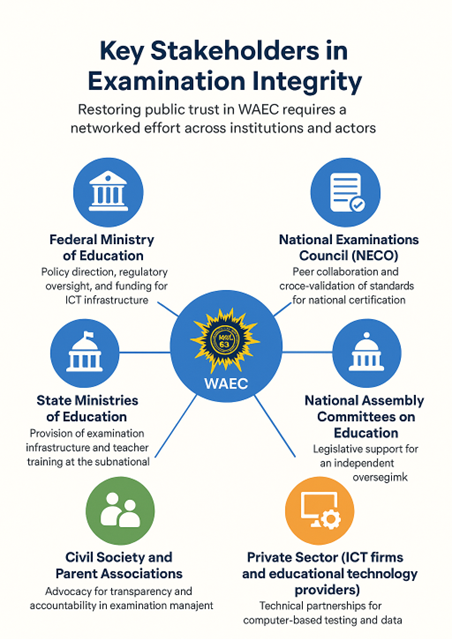
Restoring public trust in WAEC demands cooperation across a network of institutions and actors. Collaboration among these stakeholders ensures credibility, transparency, and public confidence in Nigeria’s examination system.
● Federal Ministry of Education: Policy direction, regulatory oversight, and funding for ICT infrastructure.
● WAEC Nigeria National Office: Core responsibility for examination administration, quality control, and communication.
● National Examinations Council (NECO): Peer collaboration and cross-validation of standards to ensure parity in national certification.
● National Assembly Committees on Education: Legislative support for an independent oversight framework.
● State Ministries of Education: Provision of examination infrastructure and teacher training at the subnational level.
● Civil Society and Parent Associations: Advocacy for transparency and accountability in examination management.
Private Sector (ICT firms and educational technology providers): Technical partnerships for computer-based testing and data security.
3. Lessons from Other Examination Bodies
Reforms across Africa provide instructive lessons for Nigeria. Three countries—each representing a distinct region of the continent, West, East, and South—have pioneered multidimensional approaches to tackling the complex challenges that beset public examinations.
The Kenya National Examinations Council (KNEC) adopted a National Examination Integrity Framework in 2016, combining ICT-driven monitoring with real-time publication of examination data.
Ghana’s WAEC office reinforced its internal audit mechanisms and collaborated with the Bureau of National Investigations to curb malpractice, resulting in a marked reduction in reported irregularities.
South Africa’s Umalusi Council sustains credibility through legislative independence and annual integrity audits, ensuring transparency and public confidence in certification.
Table showing comparative analysis of the examination process in three African countries
|
Country |
Key Challenge |
Reform Measures |
Communication Approach |
Evident Outcome |
|
Kenya (KNEC) |
Paper leaks; impersonations |
Biometric registration; secure, containerised paper handling |
Circulars with firm deadlines; publicised penalties |
Fewer mass cancellations post-2016; improved integrity |
|
South Africa (NSC/Umalusi) |
Cheating; printing errors |
Independent oversight (Umalusi) validates items and irregularities |
Media briefings with integrity verdict |
In 2024: No systemic leaks; 407 cases disclosed transparently |
|
Ghana (WAEC-GH) |
Social media leaks; collusion |
QR-coded papers; targeted arrests |
Public dashboards listing cancellations |
Greater transparency and deterrence |
Three key lessons stand out for Nigeria.
First, independence builds integrity: South Africa’s model shows that when examination results are validated by a neutral oversight body, public trust deepens.
Second, technology and logistics must work hand in hand: Kenya’s integration of biometric verification and secure paper handling effectively eliminated impersonation and leakages.
Third, transparency remains the strongest safeguard: Ghana’s practice of publishing cancellations by category fostered accountability and reinforced public confidence in its examination system.
4. POLICY OPTIONS
Addressing WAEC’s reliability challenges requires a comprehensive, multi-layered reform strategy. Two principal pathways merit consideration.
Option A – Strengthening WAEC from Within
1. Accelerate Computer-Based Testing (CBT):
Begin with objective tests in 2026 and expand to essay-based assessments once the infrastructure is mature.
2. Improve Logistics and Contingency Planning:
Establish regional secure printing hubs; deploy real-time paper tracking; partner with power firms to prevent disruptions.
3. Reinforce Result-Processing Systems:
Adopt dual-layered digital systems with automatic error detection and cloud backup. Conduct pre-release stress tests and maintain quick-fix protocols.
4. Institutionalise Crisis Communication:
Implement structured media briefings, real-time dashboards, and clear data on withheld results.
Option B – WAEC Trust Restoration and Modernisation Initiative (WTRMI)
1. Full Digital Examinations:
Integrate biometric registration, e-PIN verification, and digital capture of scripts to eliminate impersonation and ghost candidates.
2. Decentralised Logistics Reform:
Develop regional printing hubs with tamper-proof technologies and independent monitors. Form an emergency logistics taskforce to manage disruptions.
3. Independent Integrity Oversight:
Establish an Examination Integrity Panel, akin to South Africa’s Umalusi. The proposed Examination Integrity Panel should be constituted under the joint authority of the Federal Ministry of Education and WAEC Council, with observer status for civil society and academic bodies. Its mandate would be statutory, reporting annually to the National Council on Education and making its findings publicly available. This arrangement balances independence with institutional accountability.
4. Stakeholder Engagement and Transparency:
Hold quarterly public briefings, issue integrity bulletins during marking, and maintain open complaint channels to rebuild stakeholder confidence.
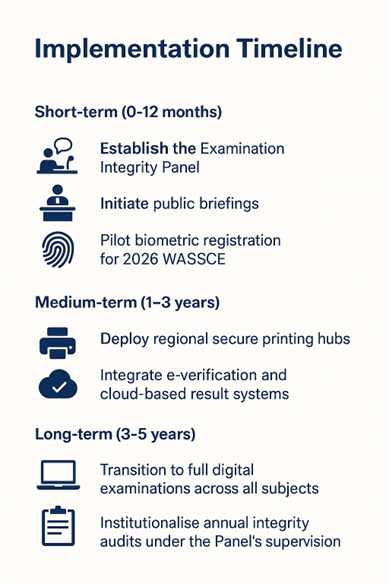
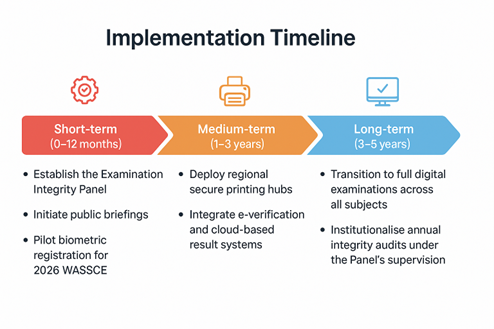
Implementation Timeline
Short-term (0–12 months): Establish the Examination Integrity Panel; initiate public briefings; pilot biometric registration for 2026 WASSCE.
Medium-term (1–3 years): Deploy regional secure printing hubs; integrate e-verification and cloud-based result systems.
Long-term (3–5 years): Transition to full digital examinations across all subjects; institutionalise annual integrity audits under the Panel’s supervision.
5. RECOMMENDATIONS
Restoring confidence in WAEC calls for a reform agenda that is both ambitious in scope and practical in execution. The recommendations below correspond directly with the four strategic pillars outlined in the proposed policy options.
1. Fast-Track Computer-Based Testing (CBT):
Pilot CBT in core subjects by 2026. Government should finance infrastructure upgrades in public schools, while private schools meet ICT standards. Introduce biometric verification to eliminate impersonation. For rural areas, designate community-based CBT centres supported by state governments.
2. Strengthen Logistics and Infrastructure Resilience:
Establish regional secure printing hubs using barcoding and QR tracking. Create a trained logistics taskforce for rapid response to emergencies such as paper shortages or power failures. Guarantee reliable electricity through generators or solar systems.
3. Build Robust and Auditable Result Systems:
Implement redundant digital result platforms with real-time error detection. Engage independent IT auditors annually to stress-test systems before release. Maintain transparent audit trails and cloud-backed result portals to prevent downtime.
4. Institutionalise Oversight and Transparency:
Create an Independent Examination Integrity Panel to validate WAEC’s processes before publication. Issue periodic integrity bulletins detailing investigations, withheld results, and timelines. Adopt proactive communication—regular media briefings, accessible dashboards, and stakeholder feedback loops.
6. CONCLUSION: REBUILDING INTEGRITY THROUGH REFORM
WAEC’s fragility lies not merely in technical failings but in a deeper rupture of public confidence. For more than seven decades, its certificates have stood as emblems of academic honour across West Africa. Today, that honour is under strain. If unaddressed, the crisis will entrench cynicism and erode confidence in Nigeria’s educational potential.
Yet adversity can be a crucible for renewal. The experiences of Ghana, Kenya, and South Africa affirm that reliability in assessment systems thrives where transparency, oversight, and technology converge. By modernising its systems, decentralising operations, and embedding independent scrutiny, Nigeria can restore the integrity of WAEC and reaffirm its leadership in regional education.
The task will demand courage, resources, and sustained resolve. But if pursued with conviction, it can yield an institution renewed in purpose and integrity—one that secures the futures of millions and restores the nation’s belief that merit, not manipulation, must determine achievement.