
Refuelling stations remain concentrated in Lagos, Abuja, and coastal corridors, leaving northern and rural regions underserved. Price benchmarks of N230 per standard cubic metre are inconsistently enforced, with private operators often charging above the official rate, eroding anticipated cost savings. Conversion costs ranging from N600,000 to N1.5 million have further restricted participation largely to commercial fleets, while safety lapses—most notably the March 2025 Nyanya explosion—expose gaps in kit quality control and inspection systems. Regional disparities further limit nationwide benefits and risk political discontent.
To ensure CNG delivers real transport-cost relief, five priorities are urgent: enforce transparent pricing, expand stations equitably, standardise kits and inspections, provide financing for high-use fleets, and publish reliable data for monitoring. Without these reforms, the Pi-CNG risks remaining a political showcase with minimal welfare gain.
Table 1: Tracking the CNG Transition: Core Indicators and Implications (2023–2025)
|
Indicator |
2023 (Baseline) |
2025 (Current) |
Change/Implication |
|
Average petrol price |
N238/L |
N1, 037.66/L |
+336% – Severe pressure on households and transport |
|
Average intracity fare |
N650 |
N2, 300 |
+254% – strong inflationary spillover |
|
Reported CNG conversions |
– |
>100, 000 vehicles |
Initial momentum; infrastructure lag limits reach |
|
Operational CNG stations |
19 |
Target: 150 |
Undersupply and regional inequality |
|
Estimated fuel-cost savings (commercial fleets) |
– |
30-40% (modelled) |
Gains are conditional on station density and kit quality |
Nigeria’s Transport-Cost Emergency and the Case for CNG
Established in 2023, the Presidential Compressed Natural Gas Initiative (Pi-CNG) represents a central element of the Tinubu administration’s policy response to the economic disruptions following fuel subsidy removal. Nigeria’s continued reliance on petrol, coupled with high domestic fuel prices, averaging ₦1,037.66 per litre as of June 2025, underscores the urgency of affordable alternatives to reduce transport costs and enhance energy security.
Pi-CNG is designed to accelerate Nigeria’s transition toward cleaner and more cost-effective transport energy. The programme aims to convert one million vehicles to compressed natural gas (CNG) by 2027, combining fiscal incentives for vehicle conversion with financing for 200,000 new CNG buses and tricycles, alongside the development of refuelling infrastructure, conversion centres, and virtual gas distribution networks. Beyond immediate cost relief, the initiative seeks to stimulate domestic manufacturing, promote local assembly, and generate employment across Nigeria’s emerging gas-to-mobility value chain.
However, the programme’s rapid rollout—claiming over 100,000 vehicles converted since 2023—has outpaced critical supporting infrastructure, including station coverage, kit quality assurance, and equitable geographic deployment. These gaps have produced bottlenecks, price volatility, and uneven adoption, limiting the initiative’s capacity to deliver the projected welfare and energy-security benefits.
While official government communications established a benchmark retail price for compressed natural gas (CNG) and projected conversion affordability, market realities have diverged sharply from these estimates. Retail CNG prices fluctuate across operators, while the cost of conversion kits and installation has risen, with reported ranges between ₦600,000 and ₦1,500,000. Compounding these challenges, the deployment of refuelling stations has lagged behind vehicle uptake, creating long queues and access bottlenecks that erode the anticipated fuel-cost savings.
Official data highlight the pressing need for alternative fuels. According to the National Bureau of Statistics, the average petrol price reached ₦1,037.66 per litre in June 2025, intensifying pressure on households and transport operators to seek more affordable energy options.
Table 2: Recent CNG Market Indicators
|
Indicator |
Value/finding |
|
Vehicles converted |
|
|
Average petrol price |
|
|
Conversion cost (market) |
|
|
Operational stations |
|
|
Notable safety incident |
Nyanya trailer crash (Mar 2025): multiple fatalities involving a CNG-powered vehicle |
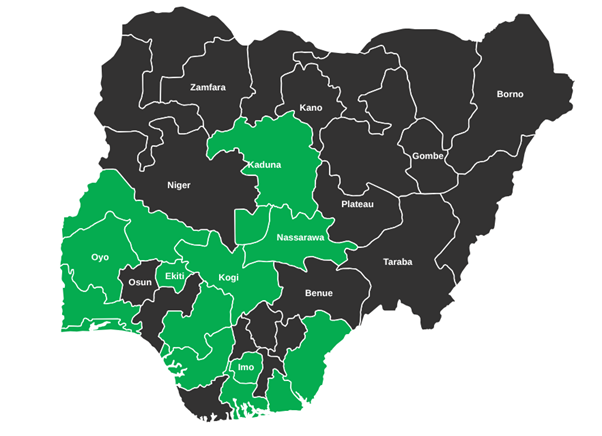
However, in terms of performance at state and zonal levels, implementation has been geographically uneven: conversion centres and functioning stations are concentrated in Lagos, the Abuja corridor, and a few coastal/localised hubs, while many northern and remote states report poor or no practical access. This clustering produces zonal inequities in realised transport cost savings and job creation, and risks political backlash in underserved states. Pi-CNG documents and press coverage show expansion targets and pilot clusters but also reveal localised shortfalls in station coverage and in the availability of conversion workshops.
Figure 1: Map of Nigeria Showing States With Active (Green) Conversion Incentive Programme
Source: Pci.gov.ng
Fault Lines in the CNG Rollout
A closer look at the programme’s early performance shows clear fault lines—social, political, economic, and psychological—that must be confronted if the CNG agenda is to endure.
● Socio-culturally, driver unions and community groups have been split between enthusiasm for cheaper fuel and mistrust due to inconsistent savings and safety reports; public perceptions are sensitive to high-visibility incidents.
● Politically, uneven station deployment raises equity concerns among state leaders. Some leaders have expressed concerns about fairness, with some governors publicly warning that high conversion costs hinder adoption.
● Economically, potential large savings for high-use commercial fleets are undermined when station scarcity or higher retail CNG prices prevail,reducing the expected macroeconomic cushion against petrol price shocks.
● Psychologically, safety incidents (e.g., the March 2025 Nyanya crash) amplify anxiety, slowing voluntary adoption. The incidents have created anxiety among drivers and commuters, slowing voluntary adoption and increasing demand for stricter certification and inspection.
Institutional Fragmentation and the Case for a Statutory CNG Governance Structure
The implementation of Pi-CNG involves multiple actors, including the Pi-CNG Secretariat (PCNGI), the Federal Ministry of Petroleum Resources/Nigerian National Petroleum Company Limited (NNPCL), the Nigerian Midstream and Downstream Petroleum Regulatory Authority (NMDPRA), the Standards Organisation of Nigeria (SON), state governments, private operators of CNG stations and conversion workshops, and transport unions. Interactions among these stakeholders largely shape retail pricing, infrastructure rollout, kit quality standards, and regulatory enforcement.
Despite its central coordinating role, the Pi-CNG Secretariat operates within a fragmented bureaucratic landscape, lacking a unified regulatory command structure. While the Secretariat oversees reporting and programme monitoring, its authority over NMDPRA (pricing), SON (standards), and NNPCL (supply) remains advisory rather than binding. The absence of a statutory framework (such as a CNG Vehicle Conversion Regulation) creates blurred accountability and leaves implementation dependent on inter-ministerial goodwill rather than enforceable mandates.
Policy diagnostics classify this as a “Type II coordination failure”, in which multiple capable agencies operate without a shared operational rulebook. The resulting fragmentation has contributed to pricing variability, uneven station deployment, and inconsistent kit quality, undermining the programme’s effectiveness.
Addressing these governance gaps would require either:
● Presidential Order explicitly assigning lead-agency powers and authority to the Pi-CNG Secretariat, or
● Dedicated CNG Transition Act to codify roles, budgets, and reporting obligations.
Such measures would clarify accountability, strengthen enforcement, and enhance the likelihood that Pi-CNG achieves its stated goals for energy transition, cost reduction, and industrial development.
Global Lessons: What Nigeria Can Learn
International experience demonstrates that large-scale CNG programmes can achieve rapid adoption when supply, infrastructure, regulatory frameworks, and demand-side incentives are aligned but can stall or fail when any link in this chain is weak. The following cases illustrate key successes and challenges, while the accompanying table summarises headline indicators and principal policy instruments from leading adopter countries.
India: Mandates, Stations and Manufacturer Participation
India’s CNG rollout, particularly in Delhi, highlights the effectiveness of combining legal mandates, OEM participation, and station network expansion. Court-directed conversion of public transport in the late 1990s and early 2000s sharply reduced particulate matter (PM) and carbon monoxide (CO) levels, creating sustained urban demand for CNG (media.rff.org, 2025). Yet India also illustrates supply-side constraints: rapid vehicle growth periodically led to pump shortages and regional price disparities, prompting parliamentary scrutiny and ministry responses on station allocation. These outcomes underscore that station deployment, and supply planning must be synchronised with vehicle conversion targets.
Pakistan: Price Incentives and Risks of Gas Allocation Politics
Pakistan’s programme, operational since the early 1990s, demonstrates the power of private-sector investment and strong price differentials between CNG and conventional fuels to drive mass retrofits (HRPUB, 2025). However, the country also reveals vulnerabilities: domestic gas allocation limits and regulatory shifts, such as curbs during peak household demand, can abruptly restrict CNG availability, forcing reconversion or operational reductions. This highlights the importance of fuel-resource management and prioritisation between domestic and transport needs.
Argentina: Certified Kits and a Mature Retrofit
With over two million natural gas vehicles historically, Argentina illustrates how a mature retrofit industry, clear certification standards, and fiscal incentives that reduce relative fuel costs can support mass adoption, particularly among taxis. Data from ENARGAS indicate that retail affordability, local manufacturing/service ecosystems, and explicit regulatory frameworks for cylinder certification were essential to scaling adoption (enargas.gob.ar, 2025). Argentina also highlights resilience risks, as weather- or supply-driven gas disruptions can temporarily close stations, emphasising the need for contingency planning.
Italy: The Power of OEM Bi-Fuel Models
In Italy, uptake relied more on OEM factory-built bi-fuel models than retrofits, complemented by strict EU-level safety and emissions standards for tanks and equipment (ReportLinker, 2025). Italy’s experience underscores the value of manufacturer involvement, integrated factory warranties, and harmonised safety standards in achieving reliable and scalable adoption.
These cases collectively indicate that while policy mandates, fiscal incentives, and regulatory clarity drive demand, the effectiveness of CNG programmes ultimately hinges on coordinated supply management, robust infrastructure, and contingency planning—lessons directly relevant to Nigeria’s Pi-CNG rollout.
Table 3: Global CNG Programme Indicators and Policy Instruments
|
Country |
Programme Start |
Natural Gas Vehicle (NGV) Fleets |
Key Policy Instruments |
Notable Outcomes/Risks |
|
India |
Late 1990s |
3.15 million |
Court-mandated public transport conversion; OEM participation; station expansion |
Sharp reductions in PM & CO, pump shortages, and regional price disparities |
|
Pakistan |
Early 1990s |
3.0 million |
Price differential incentives; private investment |
Rapid uptake; supply rationing during peak domestic gas demand |
|
Argentina |
1990s-present |
>2 million |
Fiscal incentives; certified retrofit kits; robust certification; local service ecosystem |
Widespread adoption, particularly taxis; resilience risks from supply disruptions |
|
Italy |
2000s |
>1 million |
OEM factory-built models; EU safety & emissions standards; harmonised cylinder certification |
Reliable adoption requires manufacturer involvement; weather/supply disruptions managed through standards |
Source: angva.org, enargas.gob.ar, ReportLinker
Cross-Cutting Lessons for Nigeria
-
Synchronise station rollout with vehicle conversions. Conversion targets must be matched by the deployment of refuelling infrastructure and assurance of a consistent gas supply. Failure to coordinate these elements can generate long queues, fuel price volatility, and political backlash, undermining public confidence in the programme.
-
Maintain transparent and enforceable retail pricing. Sustained price differentials between CNG and conventional fuels are critical to adoption. Where private operators fail to adhere to benchmark pricing, projected payback periods are extended and uptake slows.
-
Enforce kit standards and leverage OEM involvement. Robust cylinder and conversion kit standards, independent certification, and manufacturer warranties mitigate safety risks and strengthen public trust, encouraging broader adoption.
-
Prioritise high-mileage fleets for rapid cost relief. Commercial operators, including taxis, buses, and other high-use vehicles, experience the fastest payback and greatest operational savings. Successful programmes globally have often targeted these segments first to demonstrate immediate benefits.
-
Plan for gas supply contingencies. Experiences from countries with competing domestic gas demands highlight the importance of ring-fencing transport allocations or developing seasonal and backup supply strategies to prevent interruptions in service.
A Coherent Policy Package for Nigeria’s CNG Future
Nigeria’s Pi-CNG should be strengthened, not replaced. However, persistent gaps in station coverage, price discipline, kit quality, and data transparency continue to limit programme impact.
The following policy and implementation package outlines actionable measures to address these gaps while scaling adoption and improving outcomes.
1. Infrastructure and Equitable Station Rollout
● Action: Adopt a legally binding Station Rollout Plan, targeting at least 150 stations by 2025 with zonal allocation.
● Programme: Fast-track public-private partnerships (PPPs) with NNPC, Axxela, and private operators to construct compression plants and island stations in underserved zones; prioritise trunk routes and commercial hubs.
● Monitoring: Stations per 1,000 converted vehicles by state (target ≥1 station per 1,000 conversions within 12 months).
● Fiscal Note: Estimated ₦80 billion capital requirement via PPPs, with 40% from private participation.
2. Transparent and Enforceable Retail Pricing
● Action: Publish a statutory tariff formula and empower NMDPRA to monitor compliance and impose fines.
● Programme: Issue weekly public price bulletins and sanction non-compliant operators.
● Monitoring: Compare the median retail CNG price against the official formula every week.
3. Kit Standards, Certification, and Safety Enforcement
● Action: Enforce ISO/UNECE-aligned technical standards for cylinders, valves, and kits; mandate third-party certification, installer accreditation, and post-conversion inspection.
● Programme: Fast-track SON regulations, establish an accredited lab network, and fund the training and certification of 500 installers in year one.
● Monitoring: Percentage of conversions using certified kits with valid inspection stickers.
● Fiscal Note: Approximately ₦10 billion for certification labs and training infrastructure.
4. Finance for High-Mileage Commercial Fleets
● Action: Provide concessional loans, output-based conversion vouchers, or leasing schemes focused on taxis, buses, and haulage fleets rather than blanket consumer rebates.
● Programme: Partner with CBN/NIRSAL to provide 0–5% interest loans and fleet conversion vouchers for vehicles meeting utilisation thresholds.
● Monitoring: Share of conversions in commercial fleets; average payback period.
5. Regional Equity Through Allocation Rules
● Action: Implement zonal equity rules for station siting and conversion incentives (e.g., minimum station presence per geopolitical zone within defined timelines).
● Programme: Ring-fence 30% of subsidies and stations for underserved regions.
● Monitoring: Conversions per 10,000 population by zone.
6. Data Transparency and Independent Monitoring
● Action: Establish a public Pi-CNG Data Portal publishing vehicle registries, station geolocations, weekly retail prices, and certified installer lists; mandate annual third-party evaluation.
● Programme: Contract a neutral research partner for a 24-month impact evaluation covering fuel consumption, queue times, and safety incidents.
● Monitoring: Timeliness and completeness of public datasets, reported quarterly.
7. Public Engagement and Driver Support System
● Action: Create a Driver Conversion Support Unit for outreach, helplines, and public demonstrations.
● Programme: Implement a national media campaign in collaboration with NURTW, RTEAN, and state transport agencies.
● Monitoring: Driver satisfaction and incidence of misinformation, tracked quarterly.
8. Gas Supply Security and Contingency Planning
● Action: Secure conditional gas-allocation MOUs, diversify compression sites, and enable bi-fuel options.
● Programme: Formalise MOUs between NNPC, Axxela, and distribution partners to guarantee minimum daily capacity per region.
● Monitoring: Percentage of stations meeting minimum daily supply thresholds.
Policy Implication: By aligning infrastructure, pricing, kit standards, finance, and supply planning, Nigeria can accelerate CNG adoption while mitigating operational bottlenecks, regional disparities, and safety risks. Coordinated implementation across these eight domains is critical to achieving the one million vehicle conversion target by 2027 and to realising broader energy, economic, and environmental benefits.
Financing, Risk, and the Political Economy of Implementation
Fiscal Feasibility and Funding Models
Preliminary estimates place the full Pi-CNG infrastructure expansion at N90–N100 billion. To mitigate fiscal risks:
-
Ring-fence existing gas infrastructure funds under the Midstream and Downstream Gas Infrastructure Fund (MDGIF) for CNG-specific investments.
-
Leverage private-sector financing through PPP structures offering guaranteed offtake or tax offsets, reducing the need for direct subsidies.
-
Adopt phased subsidies by front-loading support for high-use commercial fleets while tapering household incentives after year two.
-
Publish annual cost–benefit audits, linking budget allocations to verifiable reductions in per-litre transport costs.
Without fiscal transparency and phased financing, CNG risks joining the long list of underfunded energy-transition programmes that begin with ambition but falter in execution.
Table 4: Key Risks and Mitigation Measures
Risk
Likelihood
Impact
Mitigation
Gas supply disruption
Medium
High
Maintain dual-fuel flexibility; secure long-term allocation contracts
Private-sector reluctance
Medium
Medium
Offer tax incentives and a transparent PPP framework to attract investment
Regional inequity
High
High
Implement zonal rollout targets to ensure balanced geographic coverage
Safety incidents
Medium
High
Enforce certification standards and conduct regular inspections
Public mistrusts
Medium
Medium
Deploy a target communication campaign and establish a driver support hotline
-
Table 5: Monitoring and Evaluation Framework
|
Indicator |
Target/Benchmark |
Reporting Body |
|
Average retail CNG price vs. benchmark |
≤5% variance |
NMDPRA |
|
Active CNG stations |
≥150 by Q4 2025 |
Pi-CNG Secretariat |
|
Fleet conversion ratio (commercial/public) |
≥60% by 2026 |
NBS |
|
Certified installers trained |
≥500 |
SON |
|
Regional conversion coverage |
Minimum 3 stations per zone |
Pi-CNG Secretariat |
Table 6: Stakeholder Incentives and Points of Leverage
|
Stakeholder |
Interest/Role |
Potential Resistance or Leverage |
|
Pi-CNG Secretariat |
Programme coordination |
Requires clear mandate, authority and funding |
|
NNPCL/Axxela |
Infrastructure and gas supply |
May prioritise profit over equity in station deployment |
|
NMDPRA |
Pricing regulation |
Needs capacity for retail monitoring |
|
SON |
Kit certification |
Requires budget, technical support and laboratory infrastructure |
|
Transport unions |
Adoption drivers |
Resistance possible without fleet-target incentives |
|
State governments |
Local rollout |
Demand equitable station distribution |
Policy Implication: A coordinated approach across fiscal planning, risk mitigation, and stakeholder engagement is essential to realise Pi-CNG’s one-million vehicle conversion target. Aligning incentives, establishing enforceable monitoring frameworks, and securing both public and private financing are critical to ensuring that the programme delivers measurable energy, cost, and environmental outcomes.
Policy Recommendations
The following recommendations set out a clear, actionable path to restore confidence in the CNG transition and anchor it on principles of equity, safety, and disciplined implementation.
-
Accelerate station rollout with equitable zonal coverage.
-
Enforce transparent pricing and statutory tariff adherence.
-
Mandate kit standards, certification, and post-conversion inspections.
-
Prioritise high-mileage commercial fleets for rapid cost relief.
-
Ring-fence support for underserved northern and rural states.
-
Enhance data transparency and commission an independent evaluation.
-
Engage driver unions and communities through outreach, helplines, and demonstrations.
-
Secure gas supply and develop contingency plans.
-
Establish a national M&E dashboard with quarterly reporting.
Conclusion: Turning a Conversion Drive into a Lasting Reform
Pi-CNG demonstrates political will and scale (>100,000 vehicles converted), but without equitable infrastructure, firm price discipline, fiscal realism, and mandatory kit standards, the programme cannot deliver durable nationwide reductions in transport costs.
To sustain credibility and public trust, government must treat conversion as an ecosystem reform—anchored on safety, affordability, and equity, not just numbers.
Global experience (India, Argentina, Pakistan) confirms that technical rigour, governance coordination, and fiscal transparency are the decisive factors in transforming a conversion drive into a lasting economic reform.