
The Case for Reforming Traditional Authority Governance
Traditional authority remains an indispensable yet increasingly vulnerable pillar of Nigeria’s subnational governance architecture. Across rural and periurban communities, traditional rulers, community heads, and clan leadership structures mediate disputes, uphold customary norms, facilitate local mobilisation, and serve as trusted intermediaries between citizens and elected officials. Their influence is grounded not only in cultural legitimacy but in practical governance functionality, especially where formal state presence is thin.
However, between 2020 and 2025, Nigeria recorded at least 30 publicly documented removals, suspensions, dethronements, or recognition disputes across states, including Kano, Kogi, Lagos, Anambra, Abia, Oyo, and Edo, reflecting not isolated conflicts but procedural fragilities and governance inconsistencies in the management of traditional authority. These cases underscore an urgent institutional signal: the regulatory and administrative mechanisms governing traditional leadership are increasingly unpredictable, weakly standardised, and susceptible to political incentive structures.
This issue matters now for three converging reasons:
1. Local governance pressures are intensifying.
Nigeria’s Local Government Councils face widening service-delivery gaps due to insecurity, internal migration, and fiscal strain. Traditional institutions often shoulder responsibilities in early warning, land dispute management, community mobilisation, and social cohesion. Yet procedures governing recognition, suspension, and removal of traditional rulers remain inconsistent across states, creating governance uncertainty at a time of heightened community need.
2. Political stakes of chieftaincy matters have risen.
The 2023–2026 political cycle has increased the significance of chieftaincy decisions. Several state administrations have amended chieftaincy laws or exercised executive authority to recognise, suspend, or remove traditional rulers, revealing discretionary space in state statutory frameworks and limited procedural safeguards.
3. Demographic and security shifts amplify the need for stable leadership.
Leadership vacuums disrupt land allocation, weaken intelligence pathways, and impair coordination among local government chairpersons, ward councillors, and traditional councils.
This brief does not advocate expanding the constitutional role of traditional authority or elevating it above elected governance. Rather, it argues for institutional predictability within Nigeria’s federal–state–local system. Traditional institutions operate in a constitutional grey zone: substantively influential yet legally underdefined. When recognition and removal decisions are shaped by executive discretion, inconsistently applied state laws, intracommunity contestation, or prolonged judicial delays, the subnational governance ecosystem becomes unstable. Local Government Chairpersons, Ward Councillors, traditional councils, and community heads lack consistent, documented pathways for consultation, accountability, and leadership succession.
Nigeria is experiencing an erosion of traditional governance, not because customary systems are obsolete, but because regulatory, administrative, and enforcement architectures are inconsistent, weak, and unevenly implemented. Stabilising this space requires strengthening existing state and local mechanisms, embedding due-process safeguards, institutionalising structured consultation, and modernising administrative capacity, without creating new agencies.
The Institutional Roots of the Problem
Nigeria’s rising number of traditional-authority disputes stems from a deeper structural governance failure: the absence of uniform, enforceable, and predictable mechanisms for recognising, regulating, and resolving chieftaincy matters. Although state chieftaincy laws exist, their implementation varies significantly, and enforcement rests heavily on executive interpretation and administrative capacity.
1. Local government gaps and administrative fragmentation
Local Government Councils are constitutionally responsible for community administration, yet most operate without:
● Clear procedural guidelines for recognition and removal
● Updated and digitised chieftaincy records
● Standardised engagement protocols with traditional councils
● Defined monitoring mechanisms for leadership transitions
Local government chairpersons frequently rely on informal directives rather than written criteria. Ward councillors, representing the closest elected tier to communities, are seldom formally included in advisory processes, weakening community–state feedback loops. State statutes rarely mandate local government reporting or documentation standards, resulting in fragmented archives and leadership disputes that often outlive administrative tenures.
2. State-level inconsistency and executive discretion
State chieftaincy laws differ regarding:
● Due-process steps for suspension or removal
● Investigation timelines
● Eligibility and succession criteria
● Appeal mechanisms through traditional councils
Examples: Lagos State’s 2025 chieftaincy law amendments centralise final decision-making authority in the office of the governor. Kano State’s 2020 and 2023 actions regarding the Emirate Council demonstrate statutory ambiguity around executive powers and succession processes. Such variation yields uncertainty, undermining predictability and the perceived neutrality of the state.
3. Judicial delays and uncertainty
Chieftaincy disputes commonly escalate to courts, particularly State High Courts, but judicial resolution is slow. Official judicial statistics show that customary and chieftaincy matters often take multiple years to conclude, partly because they fall into regular civil dockets without specialised scheduling.
Challenges include:
● Limited judicial expertise in customary law
● Heavy caseloads
● Absence of accelerated timelines for disputes affecting public order
● Lack of interim guidance mechanisms
This leads to prolonged governance vacuums, leaving communities without recognised leadership for extended periods.
4. Fragmented advisory systems
Councils of Traditional Rulers exist in all states, but their mandates, quorum requirements, and consultation procedures vary. Often, councils hold only advisory authority without mandatory pre-executive consultation. Integration with Local Government Councils, Ward Councillors, and state chieftaincy departments remains weak, resulting in uncoordinated decision-making and inconsistent implementation.
Institutional diagnosis: Nigeria’s challenge is not the relevance of traditional institutions but the absence of coherent rules, enforcement, verification, and appeal mechanisms linking state, local government, and community systems.
What The Evidence Shows
1. Scale and Geographic Spread
Between 2020 and 2025, at least 30 publicly reported removals or suspensions occurred across Kogi, Lagos, Anambra, Abia, Edo, Oyo, and Kano States. Disruptions cluster around election years, gubernatorial transitions, and periods of high political contestation. Actual numbers are likely higher due to the absence of a centralised registry.
2. Administrative and Economic Costs
Leadership disruptions delay or derail:
● Community mobilisation for state and federal projects
● Land allocation for social infrastructure
● Public works coordination at LGA level
● Community-level security coordination
In several LGA administrative reports, disputes resulted in project postponements averaging 3–6 months, particularly when land or community consent was required.14 Emergency response coordination also weakens where traditional structures typically provide early warning and community mobilisation.
3. Implications for Governance and Stability
Community surveys in multiple Nigerian states show that traditional institutions retain higher trust than formal state institutions among rural populations.
Disruptions:
● Fracture lineage and ruling-house consensus
● Reduce intelligence flows to authorities
● Increase intracommunity contestation
● Undermine conflict mediation
Cases perceived locally as politically influenced create lasting legitimacy costs.
4. Political Economy Drivers
Evidence indicates that disruptions often correlate with:
● Patronage networks
● Electoral mobilization strategies
● Executive succession politics
● Control over symbolic authority in strategic districts.
Even lawful interventions may be perceived as politically motivated.
5. Data and Monitoring Gaps
Neither the federal government nor state governments maintain comprehensive, standardised chieftaincy dispute databases. State records are often fragmented; LGAs maintain inconsistent or incomplete archives.
The implications include:
● Weakened state intelligence.
● Poor policy design.
● Inability to track recurring hotspots.
Conclusion: The evidence points to a systemic governance problem rather than an episodic or cultural anomaly.
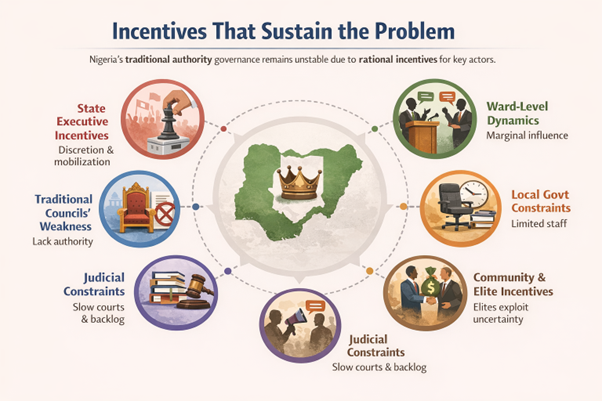
Incentives That Sustain The Problem
Nigeria’s traditional authority governance remains unstable due to rational incentives for key actors:
● State Executive Incentives: Discretion over chieftaincy affects electoral mobilization, community legitimacy, and symbolic authority.
● Local Government Constraints: Limited staff, inadequate archives, and no mandated dispute resolution timelines deprioritize leadership disputes.
● Ward-Level Dynamics: Ward councilors remain marginal, often becoming embroiled in factional politics.
● Traditional Councils’ Weakness: Lack enforcement authority, statutory autonomy, and formal documentation obligations.
● Judicial Constraints: Heavy civil dockets, low customary law capacity, and lengthy adjournments prolong disputes.
● Community and Elite Incentives: Local elites may benefit from prolonged uncertainty for bargaining leverage.
Lessons From Other Systems
Countries facing similar tensions between customary authority and democratic governance adopted institutional innovations that enhanced predictability, reduced political interference, and improved dispute resolution.
Ghana: Constitutional Protection and Internal Adjudication
Chapter 22 of the 1992 Constitution formally recognises the chieftaincy institution and prohibits Parliament from enacting laws that detract from its status. It establishes the National House of Chiefs and the Regional Houses of Chiefs. These bodies adjudicate chieftaincy disputes internally before escalation to courts.
Governance Lever: Internal adjudication and constitutional insulation reduced executive interference and increased procedural legitimacy.
Botswana: Structured Advisory Integration
Botswana’s Ntlo ya Dikgosi (House of Chiefs) is a constitutional advisory body that is required to consult on customary law bills, land governance, and tribal matters.
Governance Lever: Structured advisory integration without executive or legislative power, balancing tradition with parliamentary authority.
South Africa: Statutory Clarity and Municipal Integration
The Traditional and Khoi-San Leadership Act (2019) establishes statutory recognition, removal, and dispute procedures with mandatory municipal oversight for traditional authorities.
Governance Lever: Procedural specificity anchored in statute and formal municipal interfaces.
Morocco: Symbolic Constitutional Integration
The 2011 Constitution recognises traditional authority within a unified national identity framework.
Governance Lever: Symbolic constitutional integration promoting legitimacy and cohesion.
Key Lessons for Nigeria
1. Statutory clarity reduces discretionary removal.
2. Internal dispute resolution pathways increase autonomy and consistency.
3. Documented advisory mechanisms enhance predictability.
4. Judicial oversight mitigates political interference.
5. Political neutrality provisions reduce partisan capture.
These principles can be incorporated into existing Nigerian state laws without the proliferation of agencies.
Policy Options for Reform
The reforms proposed strengthen existing institutions, without the of setting up new agencies. The reforms’ sequencing aligns with legislative cycles, LGA planning, and NEC coordination.
A. Strengthening Procedural Safeguards
● Model Guidelines via NEC: Draft uniform due-process benchmarks, hearings, evidence standards, appeals.
● State Legal Embedding: Integrate into chieftaincy laws
● LGA Reporting Templates: Standardise transition and dispute records
● Advisory Documentation: Councils file opinions before executive action
Timeline: Short-term (1–2 years); medium-term (3–5 years)
Responsible Institutions: NEC; State Ministries of Local Government; State Houses of Assembly; Local Government Councils; State Councils of Traditional Rulers.
KPIs: States adopting model guidelines (annual NEC report); Share of executive actions with documented advisory input; Median decision timeline after petition.
Trade-offs: State resistance to perceived loss of discretion; risk of superficial compliance.
B. Improving Judicial Resolution of Disputes
● NJC Guidance: Prioritise chieftaincy matters affecting public order
● ADR Expansion: Encourage early dispute resolution
● Customary Law Training: Provide a tailored curriculum for judges and registrars
Timeline: Short-term (1–2 years); medium-term (3–5 years)
Responsible Institutions: NJC, State High Courts, Federal Ministry of Justice, and State Judicial Training Institutes.
KPIs: Median adjudication time, percentage of cases resolved via ADR, and number of judicial officers trained.
Trade-offs: Risk of rushed adjudication; resource constraints.
C. Institutionalizing structured consultation
● Mandatory Consultations: Require recorded deliberations between State Councils of Traditional Rulers and State Executive Councils.
● Local Integration: Include local government chairpersons and ward councilors in structured sessions for community-level disputes.
● Legislative Transparency: Publish consultation summaries before the amendment of chieftaincy laws.
Timeline: Short-term (1–2 years); medium-term (3–5 years)
Responsible Institutions: State Governments, State Councils of Traditional Rulers, Local Government Councils, Ward Councilors, and Houses of Assembly.
KPIs: Frequency of recorded consultations, number of joint advisory sessions, and stakeholder perception metrics.
Trade-offs: potential for symbolic consultation; administrative drag.
D. Modernizing Administrative Systems
● Digitize chieftaincy records: Apply existing state ICT frameworks; ensure data protection and access control
● Build capacity via state governance/training institutes
● Integrate early warning systems via traditional councils
Timeline: Short-term (1–2 years); medium-term (3–5 years)
Responsible Institutions: State Ministries of Local Government; State Bureau of Statistics/ICT Directorates; State Audit Offices; Federal Ministry of Interior; LG Councils.
KPIs: % LGAs with digitized records; early warning referral logs.
Trade-offs: ICT limitations in rural LGAs; uneven implementation.
The Stakes for Governance Stability
Traditional institutions remain essential where state presence is limited. Nigeria cannot restore governance coherence while traditional authority remains vulnerable to inconsistent procedures, prolonged court delays, and discretionary executive action. The issue is institutional, not cultural.
Reinforcing procedural clarity, advisory integration, administrative modernisation, and judicial efficiency will strengthen predictability and reduce governance friction. Countries that stabilised their traditional governance systems did so not by elevating customary authority above democratic institutions, but by clarifying rules, documenting processes, and embedding checks.
Nigeria can achieve similar stability within existing constitutional arrangements. Strengthening chieftaincy governance reinforces, not undermines, local democratic authority. The stakes are national: community stability, institutional credibility, and coherence of the federal order.