
Nigeria’s Open Defecation Crisis Is a Failure of Local Delivery
Open defecation (OD) in Nigeria is a long-standing public-health and governance problem. Historically, sanitation policy coalesced around the PEWASH framework (2016–2030) and subsequent National Action Plans. Yet, sustained elimination of OD has not been achieved because institutional roles and financing were not consolidated at the subnational level.
Today, the situation remains acute: the 2021 WASHNORM national survey estimates that 48 million Nigerians (23 per cent of the population) still practise open defecation, while only a minority use basic hygiene facilities, gaps that disproportionately affect rural communities and the poor. These headline figures reveal both scale and inequity and are central to this brief.
Policy failures are concentrated at state and local levels: LGAs frequently lack technical staff, predictable fiscal transfers, procurement capacity, and monitoring systems needed to transform national targets into local service delivery. As a result, donor-led interventions (e.g., SURWASH, PEWASH) have produced pockets of progress but limited national scale-up or sustainability.
The effects are multi-dimensional. Socio-cultural norms and poverty entrench OD practices; politically, weak local accountability and fragmented mandates reduce incentives for LGA performance; economically, poor sanitation imposes healthcare costs and lost productivity; psychologically, communities suffer dignity and safety harms (especially women and girls) while academically, gaps in subnational monitoring hinder rigorous evaluation of what works.
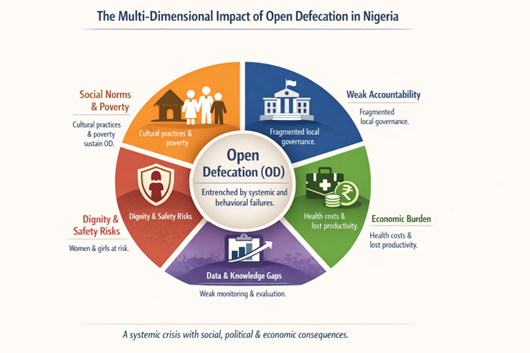
The combination of scale (tens of millions), persistent hotspots, and governance shortfalls establishes a clear need to diagnose how and why local governments underperform on SDG 6 targets. It also underscores the urgency of identifying practicable, evidence-backed strategies to eliminate OD at the LGA scale.
Systemic Failures in LGA Sanitation Delivery
In practice, sanitation failure at the LGA level follows a predictable administrative pattern rather than a lack of national policy direction.
Budgeting failures are primary. Sanitation allocations are often bundled under vague environmental health or works lines, making them vulnerable to virements during the fiscal year. Capital funds are released late or partially, while operations and maintenance (O&M) are rarely budgeted at all, leading to rapid facility breakdown after commissioning.
Procurement inefficiencies further impede delivery. Many LGAs lack skilled procurement officers, resulting in stalled tenders, weak contract specifications, and politically influenced vendor selection. Toilet construction targets are met on paper, but quality, durability, and usability are not verified.
Institutional ambiguity compounds these issues. Once facilities are built, responsibility dissolves. No department is clearly accountable for ensuring use, maintenance, or faecal-sludge management. Environmental health officers are under-resourced, while works departments treat sanitation as a one-off capital activity rather than a service chain.
Political incentives further distort priorities. Chairmen and councilors priorities visible construction over less visible behavior change, monitoring, and desludging services. Consequently, behavior change campaigns, monitoring, and maintenance receive little emphasis, and communities often revert to open defecation after initial gains.
These failures are structural, not incidental—and until addressed, they will continue to undermine progress.
Clarifying Responsibility for Sanitation Outcomes
Effective sanitation delivery requires explicit, not implied, responsibility:
● Political leadership (chairman and councilors): Approve and protect sanitation budgets; convene quarterly performance reviews; enforce accountability.
● Executive Committee: Translate national targets into annual LGA plans and approve implementation schedules.
● Works/Environment Department: Serve as the sanitation lead, responsible for outcomes such as reducing defecation and ensuring system functionality.
● Health and Education Units: Ensure WASH standards in public facilities and report usage indicators.
● Monitoring and Evaluation Units: Produce geo-tagged monthly reports and maintain performance dashboards.
Success or failure must be traceable to specific offices. Without this clarity, accountability remains abstract and ineffective.
State Control and the Limits of LGA Autonomy
Nigeria’s sanitation challenge is intensified by state dominance over LGA finances and staffing, particularly through Joint Accounts and non-autonomous personnel systems. This constrains LGAs’ ability to plan, retain skilled officers, and execute multi-year sanitation programmes.
Accordingly, performance-based transfers and sanitation grants must be designed to bypass discretionary bottlenecks, with direct conditional releases tied to verified outputs, public disclosure of LGA allocations and performance and state-level oversight focused on compliance, not control.
From Monitoring to Enforceable Accountability
Nigeria’s sanitation data systems are extensive but toothless. They measure, but rarely compel. For monitoring to serve governance, it must be linked to enforcement.
Minimum enforcement rules include the following:
● Mandatory reporting: LGAs submit monthly data as a condition for accessing funds.
● Independent verification: Third-party audits validate reported outcomes.
● Public disclosure: Performance rankings are published regularly.
● Consequences: Non-compliance triggers funding suspension or corrective measures.
Without these mechanisms, data remains an exercise in documentation rather than a tool of discipline.
What International Experience Reveals About Local Delivery
International experience offers a consistent lesson that progress depends on disciplined and incentivised local delivery.
India demonstrates the impact of strong national targets combined with local execution, though sustainability requires continued verification and behaviour change. Bangladesh highlights the effectiveness of community mobilisation and sanitation markets. Ethiopia illustrates the value of coordinated government-donor programmes. In comparison, Nepal underscores the importance of local leadership and community verification.
Table: International Experiences in Reducing Open Defecation: Policy Approaches and Lessons for Nigeria
|
Country |
Open Defecation (% of population) |
Major policy/approach |
Key stakeholders |
Key lesson for Nigeria |
|
India |
11% (2022) — major absolute decline since 2000. |
Swachh Bharat Mission (mass toilet construction + behaviour change, central performance metrics). |
Ministry of Jal Shakti / DDWS; state government; Panchayats; large NGOs; donors. |
Central targets and district incentives can drive rapid construction but must be paired with verified use, FSM, and durable behaviour-change to avoid slippage. |
|
Bangladesh |
Low single digits, very low OD by recent JMP/WASH trends. |
NGO-government partnerships, sanitation marketing, and community mobilisation. |
Local government, NGOs (BRAC, WaterAid), donors, and private sanitation suppliers. |
Strong local NGO networks + market approaches sustain uptake; FSM & hygiene remain priorities. |
|
Ethiopia |
17–29% (varied by source/year; rapid MDG-era decline). |
One WASH National Programme — coordinated government-donor delivery and community mobilisation. |
Federal/regional water bureaus; donors (UNICEF, World Bank); NGOs; woredas (districts). |
Central coordination plus donor finance can accelerate gains, but safely managed sanitation (FSM) lags and must be planned in parallel. |
|
Nepal |
7% (2022) (World Bank/JMP trends show low OD). |
Community-led sanitation, local government certification, and targeted subsidies. |
Local municipalities, national water/sanitation agencies, NGOs, and community committees. |
Local government leadership + community verification reduces OD; monitoring for slippage and FSM remain important. |
Selected country cases illustrate that sustained reductions in open defecation are achieved where national policy is matched by disciplined local implementation, clear accountability, and incentives for performance—offering practical lessons for strengthening LGA-led sanitation delivery in Nigeria.
Key Lessons for Nigeria’s Sanitation Strategy
Across these contexts, three lessons stand out:
1. Local implementation is decisive: National ambition must be matched by devolved accountability and incentives.
2. Behaviour change must accompany infrastructure: Hardware alone does not sustain progress.
3. Monitoring must track usage and service chains: Measuring construction without assessing use and faecal sludge management overstates success.
Policy Option: An LGA-Driven Sanitation Delivery Model
Nigeria does not require new frameworks; it requires disciplined execution of existing ones. Strengthening PEWASH through an LGA-driven delivery model is both practical and scalable.
1. Strengthen Institutional Capacity
Establish dedicated WASH units within LGAs, staffed with trained personnel and linked to performance grant eligibility.
Expected effect: Improved planning, procurement efficiency, and ownership.
2. Introduce Performance-Based Financing
Tie sanitation grants to verified outcomes, with ring-fenced funding for O&M.
Expected effect: Predictable resources and sustained service delivery.
3. Align Demand and Supply
Integrate behavior-change campaigns with sanitation market development and targeted subsidies.
Expected effect: Increased uptake and reduced slippage.
4. Integrate WASH into Public Services
Prioritise sanitation in schools and healthcare facilities, linked to compliance standards.
Expected effect: Enhanced health and educational outcomes.
5. Enforce Digital Monitoring and FSM
Deploy interoperable data systems with independent verification and integrate faecal-sludge management across all plans.
Expected effect: Improved accountability and full service-chain functionality.
Strengthening PEWASH through this model is evidence-based, practical, and aligned with global lessons.
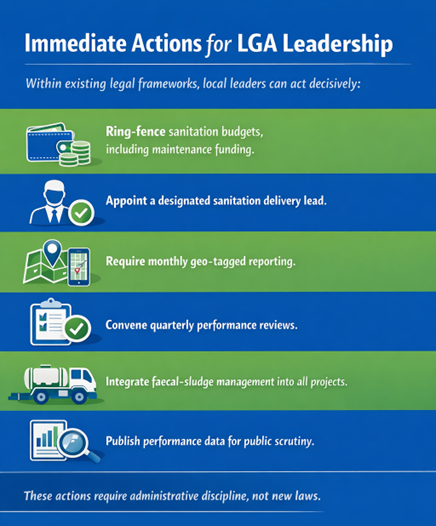
Immediate Actions for LGA Leadership
Within existing legal frameworks, local leaders can act decisively:
● Ring-fence sanitation budgets, including maintenance funding.
● Appoint a designated sanitation delivery lead.
● Require monthly geo-tagged reporting.
● Convene quarterly performance reviews.
● Integrate faecal-sludge management into all projects.
● Publish performance data for public scrutiny.
These actions require administrative discipline, not new laws.
Recommendations
Following a careful assessment of the available policy options and their practical fit within Nigeria’s institutional realities, the following actions are recommended for immediate adoption at the LGA level.
1. Strengthen LGA capacity through standardised tools, training, and staffing.
2. Adopt performance-based transfers tied to verified outcomes.
3. Promote demand creation alongside sanitation markets.
4. Integrate WASH into education and healthcare systems.
5. Enhance monitoring systems and enforce full sanitation service chains.
If implemented with rigour, these measures can accelerate reductions in OD, expand sanitation coverage, and improve health, education, and economic outcomes.
Conclusion: From Policy Commitment to Local Execution
Nigeria does not lack policy; it lacks execution. The architecture of reform—PEWASH, SURWASH, and allied initiatives—already defines what must be done. What remains unresolved is who is accountable at the LGA level, how performance is measured, and what consequences follow failure.
Without clear responsibility, enforceable monitoring, and meaningful sanctions, existing frameworks remain aspirational. The burden of change rests at the third tier of government. Until LGAs are empowered, incentivised, and held accountable, open defecation will persist, indifferent to national ambition.
To achieve SDG 6, Nigeria must return to first principles: authority must align with responsibility, resources with results, and data with consequence. Only then will policy move from paper to practice.
List of Acronyms
DDWS – Department of Drinking Water and Sanitation
FSM – Faecal Sludge Management
JMP – Joint Monitoring Programme (WHO/UNICEF)
LGA / LGAs – Local Government Area(s)
MDG – Millennium Development Goals
NGO / NGOs – Non-Governmental Organisation(s)
O&M – Operations and Maintenance
OD – Open Defecation
PEWASH – Partnership for Expanded Water Supply, Sanitation and Hygiene
SDG 6 – Sustainable Development Goal 6 (Clean Water and Sanitation)
SURWASH – Sustainable Urban and Rural Water Supply, Sanitation and Hygiene Programme
UNICEF – United Nations Children’s Fund
WASH – Water, Sanitation and Hygiene
WASHNORM – Water, Sanitation and Hygiene National Outcome Routine Mapping