
Why Gendered Gaps Matter for State Performance
Nigeria enters a period in which institutional performance will determine whether the state can manage tightening fiscal space, rapid demographic expansion and a politically competitive runway to the 2027 elections. Debt-service obligations absorb a sizeable share of federal revenues, while high informality and vulnerable employment constrain the tax base and pension contributions. In this context, gendered outcomes are not merely social disparities; they are signals of governance underperformance in budget systems, regulatory design, enforcement chains and political representation.
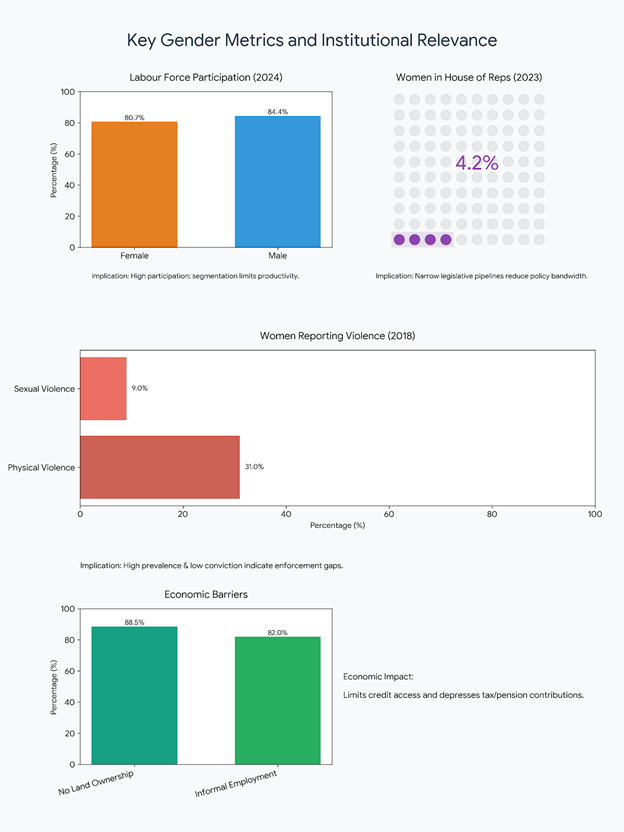
The labour market illustrates the point. Women participate actively in the labour force; the latest international series report 80.7 per cent female participation versus 84.4 per cent for men. Earlier national estimates placed women’s participation at 48 per cent. This refers to the share of women within the total labour force rather than the rate among working-age women. The problem is thus not participation alone but concentration in informal, low-protection segments, where productivity is limited, and social insurance contributions are minimal.
In the National Assembly, women’s representation remains exceptionally narrow. At 4.2 per cent in the House of Representatives, this is well below global norms. Representation at this level shapes committee attention, budget scrutiny and oversight intensity in sectors with high developmental multipliers. On protection, the NDHS 2018 finds 31 per cent of women aged 15–49 report physical violence and 9 per cent sexual violence at some point; enforcement outcomes remain far below incidence, signalling weak case pipelines and low conviction probability. These gaps affect fiscal capacity, service delivery, and state legitimacy, making them central to governance and state capability.
Subnational disparities underscore the need for targeted, state-sensitive interventions. Southern states such as Lagos and Ogun show higher formal labour participation, better domestication of the Violence Against Persons (Prohibition) Act (VAPP), and more efficient GBV case processing. Northern states exhibit higher female labour informality, weaker enforcement capacity, and limited access to credit due to cultural and structural barriers. Local legislative representation also varies, with some states (e.g., Ekiti, Kwara, Rivers and Akwa Ibom) demonstrating marginally higher inclusion at the state assembly level. These differences highlight the need for targeted, state-sensitive interventions.
Institutional Diagnosis
Nigeria’s constitutional and statutory frameworks articulate equality and protection, but persistent gendered gaps arise from structural weaknesses across four domains:
Legal and implementation gaps
The Violence Against Persons (Prohibition) Act (VAPP) provides statutory tools against domestic and sexual violence, but its effectiveness varies by state. Where domestication, resourcing and inter-agency coordination are weak, prosecution rates fall and trust declines. The national–subnational split in enforcement responsibilities exacerbates inconsistency: national law without subnational capacity yields thin deterrence.
Political and representational barriers
Women’s share of seats is 4.2 per cent in the House of Representatives, with similarly low figures in the Senate. This is not primarily voter preference; it reflects institutional gatekeeping: nomination fees, opaque financing rules and network-based selection that reward resource-rich aspirants. Without disclosure and oversight of internal nomination rules, parties rationally prioritise candidates who can self-finance, narrowing pipelines long before ballots are cast.
Economic institutions and market access
Women are over-represented in informal work (data suggest 82 per cent of employed women), with minimal contracts or contributory protections. Informality is reinforced by property-rights and collateral rules: the credit architecture is collateral-centred; women hold fewer titled assets (e.g., land ownership among women is low), constraining access to formal finance and anchoring enterprises at small scale.
Protection systems and enforcement capacity
High prevalence with low convictions implies a pipeline failure, investigation, case building, evidence standards, prosecutorial practice and adjudication timelines. Where expected enforcement is low, reporting drops and impunity rises, further corroding institutional credibility.
The pattern. Across domains, binding commitments meet weak incentives and thin enforcement, producing a structural capability gap.
What The Evidence Shows
To focus policy attention, the table below summarises institutional indicators that matter for fiscal capacity, productivity and legitimacy. (Earlier estimates are acknowledged where relevant and current series are used as anchors.)
Table: Nigeria’s Key Gendered Governance Indicators
|
Indicator |
Latest Value |
Governance Implication |
|
Female Labour Participation |
High participation exists, but gendered segmentation limits overall productivity and social contributions. |
|
|
Male Labour Participation |
While the headline gap is small, structural segmentation remains the primary binding constraint. |
|
|
Women’s Share of Total Labour Force |
This is a composition share. |
|
|
Women in House of Reps |
Extremely narrow legislative pipelines reduce policy bandwidth and effective oversight. |
|
|
Physical Violence (Reported) |
High prevalence coupled with low conviction rates indicates significant enforcement gaps. |
|
|
Sexual Violence (Reported) |
Weak enforcement mechanisms reduce deterrence and institutional protection. |
|
|
Women Without Land Ownership |
Massive collateral gaps limit access to credit and hinder formal enterprise growth. |
|
|
Informal Employment (Women) |
Low protections depress productivity, long-term pensions, and tax contributions. |
Labour market quality. Despite high participation, segmentation into informality drives three governance consequences: (i) lower productivity and weak technology diffusion; (ii) limited pension and tax contributions; (iii) heightened household vulnerability.
Political representation. 4.2 per cent in the House of Representatives places Nigeria among the world’s lowest; narrow pipelines compress committee bandwidth and reduce scrutiny of high-return social sectors.
Assets, credit and firm growth. Land and titled asset gaps limit collateral eligibility, constraining women-owned firms’ scale and formalisation.
Protection and enforcement. Nigeria Demographic and Health Survey prevalence juxtaposed with thin convictions indicates weak enforcement certainty, a core determinant of legal compliance and trust.
Drivers Of Persistent Gender Gaps
Persistent gender gaps in governance in Nigeria stem from a combination of institutional barriers, entrenched social norms, and unequal access to political and economic resources that continue to constrain women’s participation and leadership.
The main drivers include:
● Party Gatekeeping
Internal rules (fees, opaque finance, patronage) create rational incentives to prefer resource-rich aspirants. Without transparency and oversight, parties internalise immediate electoral calculus over representational diversity.
● Bureaucratic Incentives
Budget offices and MDAs are judged on procedural and cash-management compliance, not on gender-differentiated outcomes. Without binding budget rules or performance consequences, gender analysis remains optional.
● Market Constraints
Collateral-based lending is rational for banks under current regulation; when women lack titled assets, exclusion is a by-product of the property-rights system, not necessarily of discriminatory intent.
● Enforcement Tolerance
With limited investigative tools, slow case management and inconsistent evidence standards, expected conviction probability is low. Citizens rationally under-report; deterrence erodes; institutions become less informative and less credible.
Global Lessons for Gendered Governance in Nigeria
Comparative experience from Rwanda, South Africa, and India shows that durable improvements in gendered governance outcomes emerge when institutional rules reshape incentives in political representation, financial systems, and enforcement capacity.
|
Country |
Outcome |
Mechanism |
Policy Implication |
|
Rwanda |
63.8% women in Parliament (Chamber of Deputies) |
Constitutional quotas; rule-bound pipelines |
Automatic compliance drives legislative diversity and strengthens attention to social sectors |
|
South Africa |
45.1% women in the National Assembly |
Party list quotas |
Persistent GBV and inequality show that high representation alone cannot substitute for enforcement capacity |
|
India |
Self-Help Groups-backed credit |
Group guarantees bypass collateral constraints |
Expand women’s access to formal finance despite slow legal reforms. |
Policy Pathways: Strengthening Gendered Governance in Nigeria
Closing gendered governance gaps requires reforms that adjust incentives, improve enforcement, and expand economic inclusion. The following pathways are prioritised by impact, feasibility, and urgency, with estimated fiscal and implementation considerations.
1. Strengthen Gender-Responsive Budgeting (High Priority)
Problem addressed: Commitments to gender equality not translating into allocations or execution.
Actions:
● Embed gender-responsive budgeting (GRB) in the MTEF and annual budget call circulars.
● Require gender budget statements specifying beneficiaries, outputs, and risks.
● Link MDAs’ performance compacts to gender-disaggregated indicators tied to service outputs.
Implementation considerations: Pilot in Health, Education, Justice over 0–12 months; scale nationwide within 36 months.
Risks: Resistance from MDAs prioritising cash compliance over gender outcomes; mitigated through KPIs and public disclosure.
Budget implications: Integration primarily uses existing budget office resources; minor costs for training and data systems.
Potential fiscal gain: Improved targeting of programmes could increase effective use of allocations by 5–10%, enhancing service delivery efficiency.
2. Improve Political Representation Incentives (Medium–High Priority)
Problem addressed: Party gatekeeping and opaque nomination finance rules limit women’s entry.
Actions:
● Mandate pre-primary disclosure of gender-segregated nomination lists and fees; require post-primary reporting.
● Publish party transparency dashboards monitored by INEC and parliamentary committees.
Implementation considerations: Introduce ahead of 2027 primaries; compliance monitored over 0–18 months.
Risks: Parties may superficially comply; mitigated through civil society oversight and public reporting.
Budget implications: Minimal; leverages INEC and parliamentary monitoring capacity.
Potential impact: Increasing women’s representation could expand legislative oversight bandwidth, enhancing social sector policy scrutiny by 15–20%.
3. Enhance GBV Enforcement Pipeline (Medium Priority)
Problem addressed: High prevalence of GBV with low convictions reduces institutional credibility.
Actions:
● Publish annual VAPP scorecards by state (domestication status, filings, convictions, case duration).
● Implement a digital case-tracking platform linking police, prosecutors, and courts; integrate basic forensic capacity standards.
Implementation considerations: Pilot in five states (0–12 months), scale to all states (12–36 months).
Risks: Limited judicial and police capacity; risk of incomplete reporting; mitigated through phased roll-out and training.
Budget implications: Initial investment for digital platforms and training; could be partly funded from existing justice reform allocations.
Potential impact: Expected conviction probability increase from current levels could deter 10–15% of repeat offenders, improving rule-of-law credibility.
4. Expand Women’s Access to Formal Markets (Medium Priority)
Problem addressed: Collateral-based lending excludes women from formal finance, limiting enterprise scale.
Actions:
● Scale group-guarantee credit schemes within DBN/BOI frameworks.
● Accelerate digital financial inclusion through simplified KYC and mobile onboarding.
● Implement beneficial-ownership verification and open contracting to support women-owned firms in procurement.
Implementation considerations: Pilot over 0–12 months; scale nationwide within 36 months.
Risks: Banking sector resistance, default risk; mitigated through risk-sharing and regulatory guidance.
Budget implications: Programmes funded largely through DBN/BOI operational budgets and donor co-financing.
Potential impact: Could increase women-owned SMEs’ access to credit by 20–25%, boosting formal enterprise growth and expanding tax contributions.
Implementation Prioritisation Summary
|
Reform |
Priority |
Timeline |
Risk |
Potential Impact |
Budget Implication |
|
Gender-responsive Budgeting |
High |
0-36 months |
MDA’s compliance |
Improved service targeting |
Low |
|
Political representation |
Medium-High |
0-18 months |
Party superficial compliance |
Increased legislative scrutiny |
Minimal |
|
GBV Enforcement Pipeline |
Medium |
0-36 months |
Police/judicial capacity |
Higher conviction, trust in law |
Moderate |
|
Women’s Market Access |
Medium |
0-36 months |
Banking resistance |
Formal enterprise growth |
Moderate |
This prioritisation enables fast, high-impact interventions while laying foundations for systemic improvements in enforcement and economic inclusion.
Closing Gendered Governance Gaps: Institutional Stakes
Nigeria’s gendered outcomes are state capability signals. Concentration of women in informal, low-protection work undermines productivity, pensions and tax revenue; narrow legislative pipelines reduce policy bandwidth and budget scrutiny; and high GBV prevalence with low convictions erodes rule-of-law credibility.
These are institutional performance problems, not peripheral social issues. The proposed pathways tighten rules, sharpen incentives, and increase enforcement certainty within existing mandates. In a tight fiscal cycle and an election-year accountability window, closing gendered governance gaps is statebuilding: it strengthens allocative credibility, enforcement legitimacy, and the state’s ability to translate commitments into outcomes.