
The Implementation Gap in Nigeria’s Digital Education Agenda
Nigeria has had an explicit national policy for ICT in education since the 2019 National Policy on ICT in Education (NPICE), which established the government’s long-term intent to integrate information and communication technologies into teaching, learning, and administration. Despite the policy and accompanying Implementation Guidelines (2019), progress has been incremental: The National Digital Literacy Framework (NITDA), 2023 and the National Digital Learning Policy (NDLP), 2023, strengthened the normative architecture, yet the gap between policy design and national classroom realities persists.
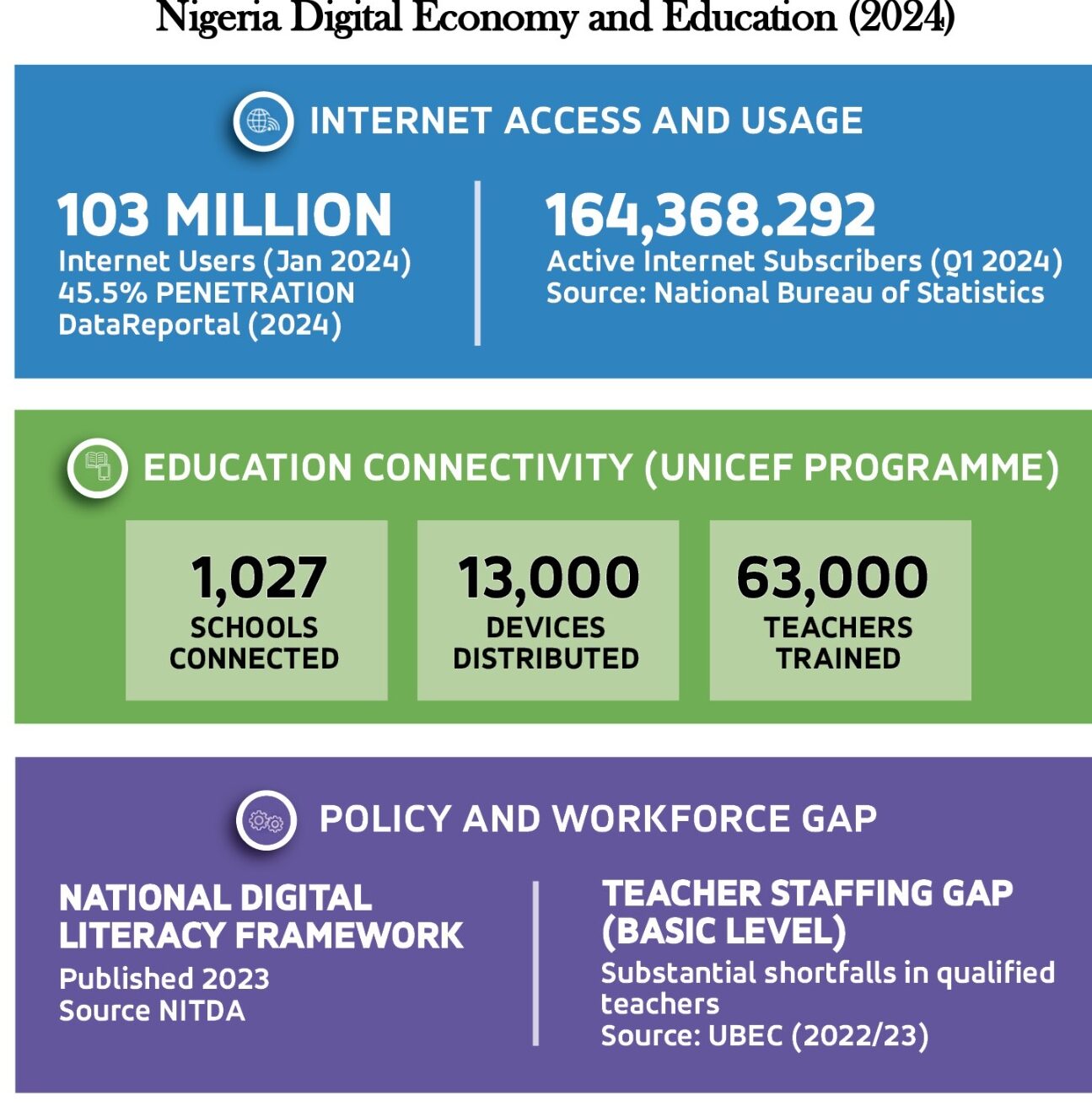
At the macro level, Nigeria’s digital footprint grew to 103.0 million internet users, 45.5% penetration as of January 2024, but those national figures mask acute school-level and regional gaps and do not equate to classroom readiness (DataReportal, 2024). Administrative telecom data show 164.37 million active internet subscriptions in Q1 2024, a household/consumer metric that does not measure school connectivity, device availability, teacher capacity, or pedagogical integration. Government frameworks have therefore failed to translate national connectivity into functional, equitable digital learning at scale because financing is fragmented and largely non-ring-fenced; monitoring and evaluation systems to track school-level inputs and learning outcomes are weak; and federal–state coordination and last-mile infrastructure (power and broadband) remain insufficient.
The Social, Institutional, and Economic Costs of Inaction
Socio-culturally, unequal digital access exacerbates urban–rural and gender divides; students in remote communities face exclusion from digital learning resources that urban peers access.
Politically and institutionally, weak federal–state implementation capacity erodes public confidence in digital education reforms and creates fragmented pilots rather than national-scale outcomes.
Economically, failure to mainstream digital literacy limits learners’ future employability in digital economies and reduces national returns on investments in broadband and education.
Psychologically, inconsistent access undermines learner motivation and teacher self-efficacy in blended pedagogy, increasing absenteeism and disengagement when digital tools are available but support is absent.
Also, low teacher competence in digital pedagogy and limited device availability constrain the adoption of ICT-enhanced curricula, reducing opportunities to develop higher-order ICT skills in primary and junior secondary cycles.
A Policy Architecture Without Execution Power
Nigeria possesses a strong policy base such as the NPICE (2019), National Implementation Guidelines (2019), NITDA (2023) and NDLP (2023) towards addressing the above challenges, yet implementation has suffered from limited ring-fenced financing, weak nationwide M&E, and fragmented federal–state coordination. Programmes by UNICEF and development partners provide proof-of-concept but have not closed the scale gap.
There is an evidence gap on how to convert national connectivity and policy intent into measurable school-level outcomes across Nigeria’s 36 states and the Federal Capital Territory (FCT).
This brief argues that Nigeria’s challenge is no longer policy design but disciplined execution. Strengthening existing policies—rather than introducing new frameworks—requires explicit sequencing, realistic financing, aligned incentives, and outcome-focused accountability. Without these, national connectivity gains will continue to bypass classrooms.
It is therefore necessary to:
(1) map state-level implementation performance and barriers,
(2) quantify teacher-training and device-coverage shortfalls against national targets,
(3) evaluate financing and M&E bottlenecks, and
(4) produce operational, evidence-based policy prescriptions that can be adopted by FME–NITDA–UBEC and state actors to move from pilot successes to national scale.
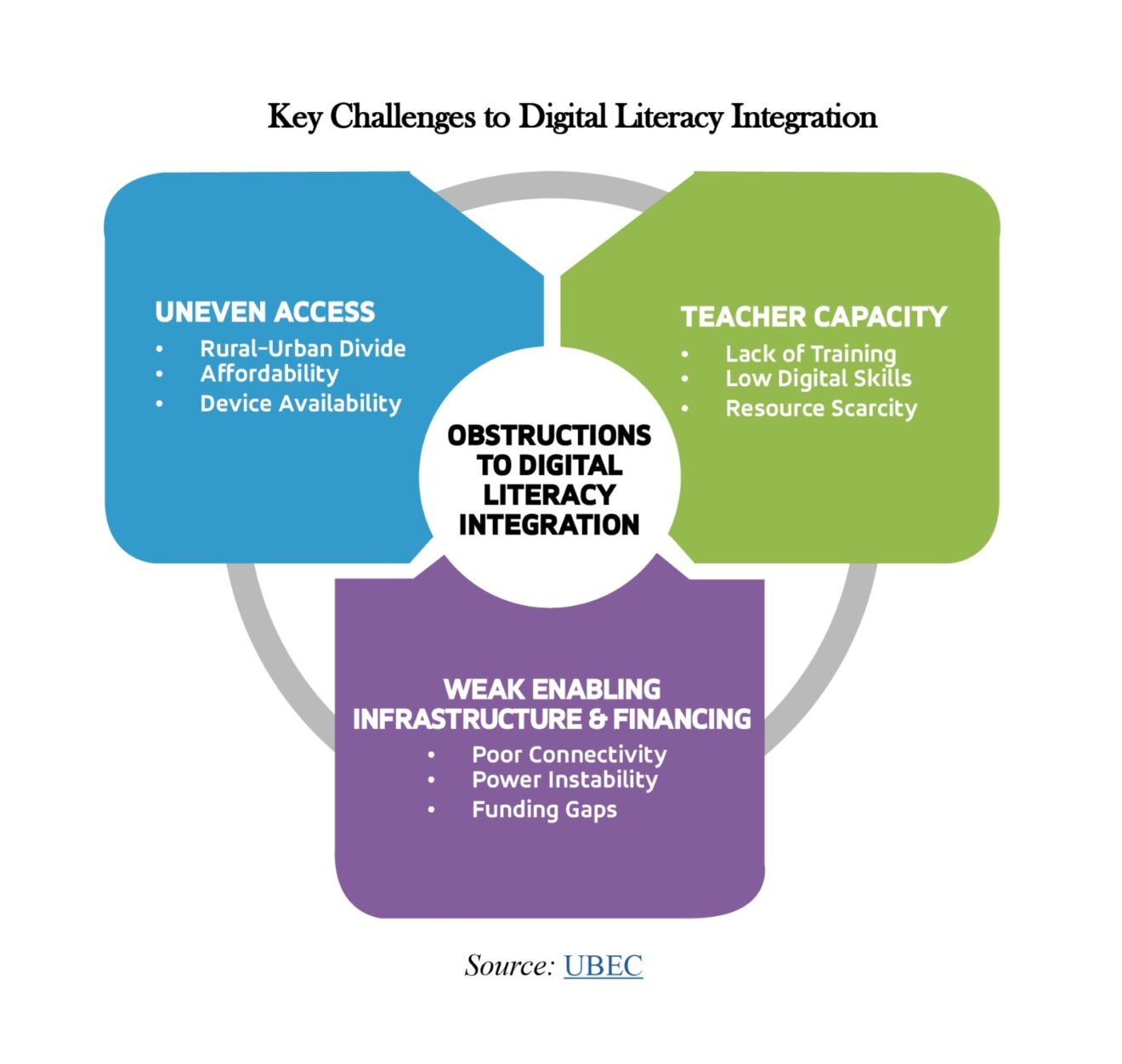
These three interlocking constraints translate into widened urban–rural learning divides, missed opportunities for 21st-century skills, and the risk that national digital targets remain aspirational rather than operational.
Comparative Perspective: What High-Performing Systems Did Differently
Countries that have progressed fastest combined (a) a clear national strategy, (b) sustained teacher development, (c) system-level infrastructure (connectivity + power), (d) institutional ownership for maintenance as well as monitoring and evaluation, and (e) iterative evaluation that adjusted programmes. The following country examples show different mixes of those elements and practical lessons for Nigeria.
Country Case Studies
-
Uruguay — Plan Ceibal (National OLPC model)
Policy measures and scale. Plan Ceibal began in 2007 with universal school connectivity and a one-device-per-child approach; by the 2010s, it supplied devices to 700,000 students and connected virtually all public schools (Ceibal institutional reports). The programme institutionalised maintenance, teacher support, and a research arm.
Outcomes. Evaluations find strong gains in access, inclusion, and motivation, but mixed short-term effects on standardised test scores, effects dependent on pedagogical integration and teacher practice rather than device presence alone.
-
Estonia — system-wide digital skills and teacher training
Policy measures and scale. Estonia’s long-term digital strategy (from the 1997 Tiigrihüpe to today’s e-Education) invested early in national school connectivity, continuous teacher upskilling (20% of teachers receive digital training annually), and integration of digital competence in curricula; recent initiatives (AI Leap) add national AI-skills rollouts for older students.
Outcomes. Estonia shows high levels of teacher readiness, wide use of digital tools in learning, and strong national M&E; results suggest that long-term investment in teacher professional development and curriculum integration produces robust digital competence across cohorts.
Lesson: Start early, sustain investment, link digital skills to assessment and teacher pipelines.
-
Rwanda — Phased Smart Classroom & national connectivity pilots
Policy measures and scale. Rwanda’s Smart Classroom, piloted and scaled in phases, combined school connectivity, content servers, teacher training, and community access; World Bank and UNICEF reviews call to extend ICT beyond “smart classrooms” and strengthen offline/local content and community connections.
Outcomes. Early evaluations show improved engagement and infrastructure gains but also highlight the need to broaden teacher training, involve the private sector for sustainability, and expand connectivity to communities.
Lesson: Pilot + phased national scale works if coupled with realistic maintenance and local content strategies.
-
India — National digital learning platforms
Policy measures and scale. India created a large digital public infrastructure for education: DIKSHA (Digital Infrastructure for Knowledge Sharing) and the PM e-VIDYA consolidation during COVID-19 aim to provide multi-mode (TV, radio, online) access to content for 250 million schoolchildren; platforms support teacher professional development and content in many languages.
Outcomes. Platforms achieved massive reach during the pandemic but exposed constraints: uneven home access, regional digital divides, and important data-security incidents that highlight governance and privacy gaps.
-
Kenya — Digital Literacy Programme (DLP) and connectivity pilots
Policy measures and scale
Kenya’s Digital Literacy Programme (DLP, launched c.2013) supplied devices to primary schools (over 20,000 of 24,000 public primaries reported served in some phases), paired with teacher devices and content; more recent DigiSchool and public-private projects have focused on school internet connectivity and community access.
Outcomes. Evaluations show improved access but note challenges: device maintenance, teacher readiness, fragmented procurement, and sustainability concerns. Partnerships emphasize the importance of local capacity and clear M&E frameworks.
Lesson: Political visibility can accelerate roll-out, but sustainability and teacher adoption are essential for learning gains.
Comparative Table: Cross-Country Approaches to Digital Education at Scale
|
Country |
Major policy measures |
Scale / key stat |
Main stakeholders |
Dominant lesson |
|
Uruguay (Plan Ceibal) |
Universal devices + school Wi-Fi; Ceibal research & maintenance center |
700,000 students; near-universal school connectivity. |
Ceibal Foundation; Ministry of Education; telcos. |
Devices + connectivity must be matched with teacher PD and pedagogical redesign. |
|
Estonia |
Long-term digital strategy; sustained teacher training; curriculum integration |
20% of teachers trained yearly; national AI rollouts 2025. |
Ministry of Education, teacher training institutes, tech partners. |
Invest early & continuously in teachers + integrate into curriculum. |
|
Rwanda |
Smart Classroom pilots; school servers; phased national rollout |
Pilot phases; World Bank recommends scale-up & offline content. |
Rwanda Ministry of Education (MoE); REB; World Bank; UNICEF; private sector. |
Phased pilots work, but expand teacher PD, maintenance & local content. |
|
India |
National learning platforms (DIKSHA, PM e-VIDYA) & multi-mode delivery |
Platforms reach 250M learners; platform security concerns documented. |
MoE; NCERT; broadcasters; states. |
Public platforms scale access but need localisation, privacy safeguards. |
|
Kenya |
Digital Literacy Programme (devices + teacher devices); DigiSchool connectivity pilots |
Devices to 20k+ primary schools in rollout phases; DigiSchool connectivity reports. |
ICT Authority; MoE; county governments; UNESCO; private partners. |
Political commitment + PPPs help roll-out; sustainability & teacher use remain bottlenecks. |
Policy Option — Strengthening Existing Policies, Not Inventing New Ones
Below are the policy options that build on already existing policies. Strengthening means turning policy provisions into funded, measurable, and time-bound programmes under clear institutional leadership.
1. Governance and Institutional Leadership
Action / Programme
-
Establish a National Digital Education Unit (NDEU) – a time-bound inter-agency unit (hosted by the Federal Ministry of Education) to operationalise NPICE/NDLF/NDLP, chaired by FME with statutory representation from NITDA, UBEC, Federal Ministry of Communications and Digital Economy (FMCD&E), and State Ministries of Education.
-
Legislate a Digital Schools Financing and Accountability Act to ring-fence federal matching funds for state school connectivity and require annual public reporting.
Stakeholders: FME (lead), NITDA, UBEC, FMCD&E, State Ministries of Education, National Assembly, Office of the Accountant General.
KPI (proposed): NDEU established within 6 months; annual ring-fenced appropriation line created in the next national budget cycle.
Rationale: Current policy documents call for coordination and M&E but lack a single, empowered operational leader to reconcile federal/state roles and procurement (NDLP; NPICE). Strengthening governance closes that implementation gap.
2. Financing, Procurement, and Long-Term Sustainability
Action / Programme
-
Create a 5-year School Connectivity and Devices Fund (SCDF): blended finance (federal budget, state counterpart, World Bank/IDA credit, donors, private sector CSR). Use results-based disbursements to states linked to M&E outcomes (schools connected, teachers certified).
-
Standardise device procurement (total cost of ownership) and require local maintenance contracts and spare parts budget lines.
Stakeholders: FME, FMF (Ministry of Finance), UBEC, World Bank, development partners, private telcos, and device vendors.
KPI (proposed): SCDF launched Year 1; at least 5% of the basic education budget ring-fenced for digital learning by Year 2.
Rationale: Policies (NPICE / Implementation Guidelines) recommend financing models but lack a national blended vehicle and procurement safeguards; ring-fencing prevents fragmentation and ensures maintenance funds.
3. Infrastructure as a Binding Constraint: Power, Connectivity, Resilience
Action / Programme
-
National School Connectivity Programme (NSCP): target priority schools (rural/low-access) with last-mile solutions (community VSAT, mobile broadband, public Wi-Fi) and concurrent School Electrification Acceleration in partnership with the Rural Electrification Agency (solar mini-grids and battery systems).
-
Mandate offline content caches (local servers / preloaded LMS) for low-bandwidth contexts.
Stakeholders: FMCD&E, NITDA, REA, State Ministries, telcos, UNICEF, private sector (Airtel/MTN partnerships).
KPI (proposed): 10,000 priority schools connected + powered within 3 years (scale up from UNICEF pilot 1,027 schools).
Rationale: National internet growth (103 million users; 164 million subscribers) does not guarantee school connectivity; targeted last-mile and power investments are preconditions for classroom use.
4. Teachers as the System Bottleneck
Action / Programme
-
Launch National Teacher Digital Certification (NTDC) (modular, blended CPD accredited by teachers’ councils), immediate target: certify 300,000 teachers in 3 years; integrate digital pedagogy into pre-service curricula at Colleges of Education and Faculties of Education.
-
Incentivise digital champions in each cluster school with small grants to lead peer coaching.
Stakeholders: FME, UBEC, Teachers’ Registration Council of Nigeria (TRCN), Colleges of Education, State SMoEs, UNICEF.
KPI (proposed): 300,000 teachers NTDC-certified in 3 years; all pre-service teacher training institutions include digital pedagogy modules within 18 months.
Rationale: UNICEF’s training of 63,000 teachers is promising, but the national teacher population and UBEC NPA coverage (47 million pupils) require far greater scale. Teacher competence is the single largest bottleneck identified in the Problem Statement.
5. Curriculum, Assessment, and Local Content Alignment
Action / Programme
-
Embed Digital Competencies (NDLF levels) into the national curriculum and assessment frameworks, integrate into teacher appraisal and student learning assessments).
-
Invest in localised, multi-lingual digital content and a national Open Educational Resources (OER) hub (hosted by NDEU/NITDA).
Stakeholders: FME, NERDC (curriculum authority), NITDA, State exam bodies, and content partners.
KPI (proposed): Digital competencies in the national curriculum by Year 1; OER hub operational by Year 2.
Rationale: Devices alone do not change learning; curriculum and assessment alignment ensure pedagogical uptake and measurable learning outcomes.
6. Monitoring, Evaluation, and Public Accountability
Action / Programme
-
Build a National Digital Education Dashboard (FME–UBEC–NITDA) linking Annual School Census data to live indicators: % schools connected, devices per 1,000 learners, teachers certified, learning outcomes. Use results-based financing triggers.
-
Mandate annual independent evaluations and open data releases.
KPI (proposed): Dashboard live within 12 months; annual public M&E reports published.
Rationale: NDLP and NPICE call for M&E, but implementation needs a living dashboard to translate policy into actionable oversight and donor reporting.
7. Equity, Inclusion, and Gender
Action / Programme
-
Require connectivity and device targets to be disaggregated by state, urban/rural, and gender; fund gender-sensitive outreach and accessibility (screen readers, low-vision interfaces).
-
Community access points for out-of-school youth and women’s digital literacy.
KPI (proposed): Disaggregated reporting mandatory from Year 1; community access points scaled from 84 (UNICEF baseline) to 500 in 3 years.
Recommendations: Priority Actions for Federal and State Actors
-
Establish a National Digital Education Unit (NDEU) hosted in the Federal Ministry of Education to coordinate NPICE/NDLF/NDLP implementation, convene FME–NITDA–UBEC–state actors, and publish annual progress reports.
-
Create a 5-year School Connectivity & Devices Fund (SCDF) (blended federal/state/donor/private finance) with ring-fenced budget lines and results-based disbursements tied to school connectivity and teacher certification.
-
Launch a targeted National School Connectivity & Electrification Programme that combines last-mile broadband (mobile/Wi-Fi/VSAT), solar mini-grids, and offline content caches to connect and power priority rural schools.
-
Implement a modular National Teacher Digital Certification (NTDC) (300,000 teachers certified in 3 years’ target) and integrate digital-pedagogy modules into all pre-service programmes.
-
Mandate the incorporation of the NITDA Digital Competency levels into national curricula and establish a national Open Educational Resources (OER) hub to host localized, multilingual learning materials.
-
Deploy a National Digital Education Dashboard (FME–UBEC–NITDA) linking Annual School Census data to live indicators (% schools connected; devices per 1,000 learners; teachers certified) and publish open annual M&E reports.
-
Require all targets and disbursements to be disaggregated by state, urban/rural, and gender, and scale community access points and accessibility features (e.g., low-vision support) to ensure equitable uptake.
Indicative Fiscal Envelope for National Digital Education Reforms (Order-of-Magnitude)
|
Reform Area |
Indicative Cost Estimate |
Notes |
|
National Digital Education Unit (NDEU) |
N500-700 million |
Covers staff, office setup, coordination systems, and operational expenses over 3-5 years |
|
School Connectivity & Device Fund (SCDF) |
N250-300 billion |
Assumes 10, 000 priority schools; blended funding (fedderal, state, donors, private sector). Includes device lifecycle and maintenance. |
|
National School Connectivity and Electrification programme |
N150-180 billion |
Last mile broadband (mobile/Wifi/VSAT) + solar mini-grids; prioritise rural and low-access schools. Include infrastructure deployment and 3-year maintenance. |
|
National Teacher Digital Certification (NTDC) |
N30-40 billion |
Modular, blended CPD for 300, 000 teachers over 3 years; includes training delivery, online platforms, and incentives for cluster ‘digital champions.’ |
|
Curriculum Alignment & OER Hub |
N5-8 billion |
Curriculum integration of NDLF competencies; development and hosting of national multilingual Open Education Resources hub. |
|
National Digital Education Dashboard |
N1-2 billion |
Design, development and operationalisation of live dashboard linking Annual School Census to indicators; annual reporting cost included. |
|
Equity, Inclusion and Community Access |
N10-12 billion |
Expansion of community access points (from 84 t0 500); gender sensitive and low-vision interfaces; targeted outreach programmes. |
Total Indicative Envelope: ~N446–542 billion over 3–5 years
Conclusion: From Policy Intent to National Outcomes
Nigeria stands at a decisive moment of implementation. While national connectivity indicators point to a widening digital footprint, the evidence leaves little room for comfort: policy ambition has yet to translate into equitable, classroom-level digital literacy.
The country is not short of frameworks. On the contrary, it has assembled a credible policy architecture, anchored by the National Policy on ICT in Education (2019) and reinforced by the National Digital Literacy Framework (2023). What is missing is not vision, but execution—specifically, an empowered operational vehicle, predictable blended financing, large-scale and standardised teacher certification, and a live monitoring and evaluation system capable of converting scattered pilots into durable national outcomes.
This policy brief therefore advances a prescriptive and action-oriented position. Nigeria should consolidate and strengthen existing policies by: (a) establishing a National Digital Education Unit with clear authority to coordinate implementation across institutions; (b) creating a blended School Connectivity and Devices Fund to ring-fence resources and guarantee full lifecycle maintenance; (c) scaling a National Teacher Digital Certification programme to professionalise digital instruction; (d) delivering targeted school connectivity and electrification at scale, moving decisively beyond pilot projects; and (e) deploying a public digital-education dashboard to ensure transparent monitoring and evaluation. Taken together, these measures provide a coherent pathway for shifting the system from fragmented experimentation to sustained, accountable national delivery.
In the final analysis, it is the strengthening of policy implementation—not the invention of new slogans—that offers the only credible, evidence-based route for Nigeria to convert national connectivity into inclusive digital literacy and, ultimately, meaningful educational transformation.
Acronyms
AI Artificial Intelligence
CPD Continuing Professional Development
CSR Corporate Social Responsibility
DIKSHA Digital Infrastructure for Knowledge Sharing
DLP Digital Literacy Programme
FCT Federal Capital Territory
FMCD&E Federal Ministry of Communications and Digital Economy
FME Federal Ministry of Education
FMF Federal Ministry of Finance
ICT Information and Communication Technology
IDA International Development Association
KPI Key Performance Indicator
LMS Learning Management System
M&E Monitoring and Evaluation
MoE Ministry of Education
NCERT National Council of Educational Research and Training
NDEU National Digital Education Unit
NDLF National Digital Literacy Framework
NDLP National Digital Learning Policy
NERDC Nigerian Educational Research and Development Council
NBS National Bureau of Statistics
NITDA National Information Technology Development Agency
NPICE National Policy on ICT in Education
NSCP National School Connectivity Programme
NTDC National Teacher Digital Certification
OER Open Educational Resources
OLPC One Laptop per Child
PPP Public–Private Partnership
REA Rural Electrification Agency
SCDF School Connectivity & Devices Fund
SMoE State Ministry of Education
TRCN Teachers’ Registration Council of Nigeria
UBEC Universal Basic Education Commission
UNESCO United Nations Educational, Scientific and Cultural Organization
UNICEF United Nations Children’s Fund
VSAT Very Small Aperture Terminal